Salmon Patties

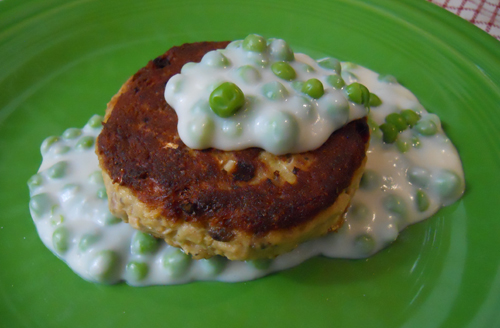
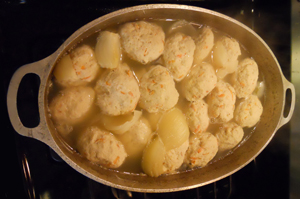
Yesterday I made one of the last comfort-food dishes of the winter season. Before the 80 degree weather made it’s way through the thick walls of our old house, I heated up a pan, whipped up some cream sauce and fried up some salmon patties for my dad. Allegedly, this is my father’s favorite dish. A throw-back to the 50’s, it really must be served with the white sauce thick with peas. I resisted the temptation to add a side of jello and canned peaches, and instead I served a nice green salad.

Salmon Patties (makes 3)

  • a large can of salmon
  • 1 egg
  • 1/2 cup bread crumbs
  • 1 diced green onion
  • 1/2 teaspoon Worcestershire sauce

Form into patties and gently heat in a pan with a little olive oil. Brown each side. Serve with a standard white sauce, seasoned with salt and pepper. Stir in a handful of frozen peas and heat slowly.

This is a plain recipe, and you can doctor it up with some dill or cumin or pepper.  Using canned salmon is not for the timid. I like to remove as much of the skin and bones as I can before mixing with the other ingredients.

Ruth’s Square Cookies and The Blue Bowl

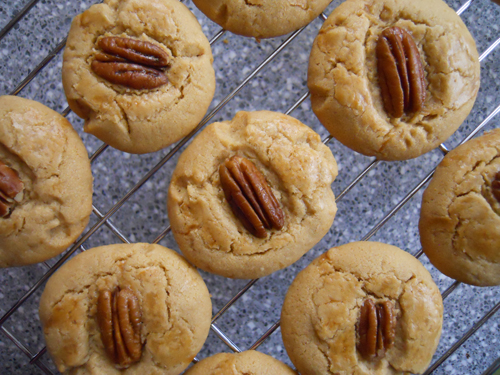
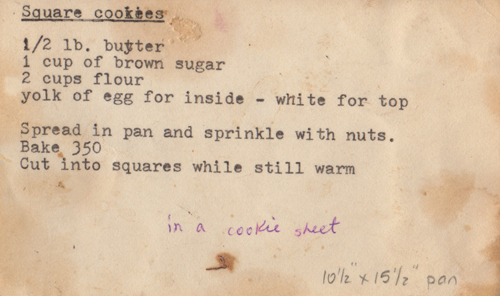
These cookies, pictured below, are from my mother’s recipe entitled “Square Cookies.” (Next fall I’ll show you her cherry cake recipe which is made using plums.)

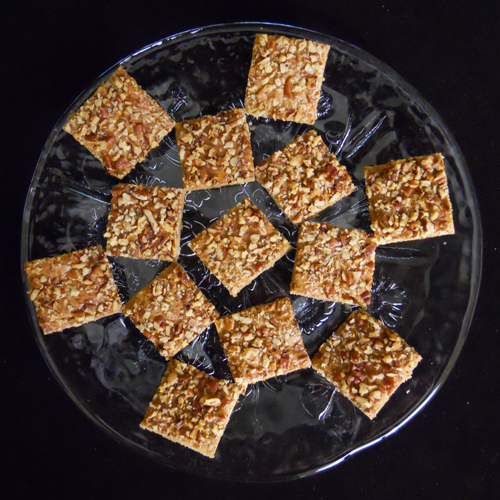
But maybe your brain prefers this next photograph, made from the same recipe:

Also called Brown Sugar Cookies, the only difference between these two versions is in the shape of the cookie and the size of the pecan pieces.

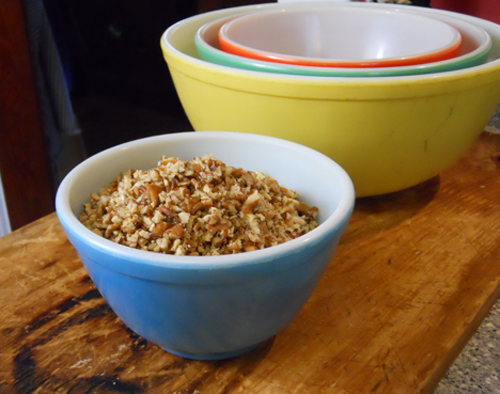
Before the age of electronics, when I was bored, I would sit on the floor of my mother’s kitchen with my back against the refrigerator and wait for a job. My first job, when I was probably three or four, was to grind nuts into the blue bowl. The blue bowl is the smallest of the colorful Pyrex nesting bowls, made in the 1950’s. My sister and I have a secret love affair with these bowls. We’re always on the look out for them. Recently, I purchased an entire set at a flea market! They are packaged carefully away in our garage, waiting for the time when my 13 year-old daughter has her own kitchen. I used to run the bowls in the dishwasher until I noticed that their luster had faded, so I gave those away and purchased a like-new set on e-bay. On the advice of my sister, these are hand-wash only.

Today I gave my son Joe the job of filling the blue bowl with chopped pecans for Grandpa’s favorite cookies, square cookies. Since Grandpa doesn’t like that many nuts I made him some of the round ones.

Cilantro Rice

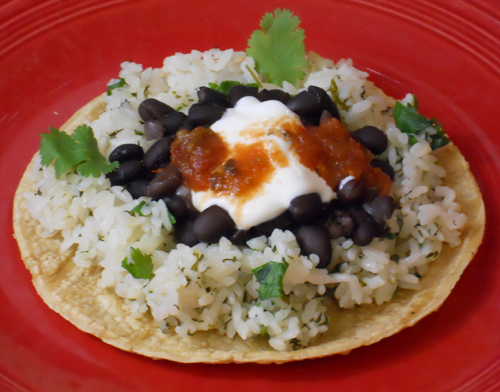
Every time I taste cilantro I am startled by how good it is. And then I forget all about it. It’s not a flavor that made its way into my Jewish mother’s kitchen and it never became a habit. But tonight I wanted to do something different with our standard black beans and rice so I very purposefully purchased a fresh bunch of cilantro at the Mexican grocery store, and added some to the rice while it cooked. It’s nice living here in our little college town, a cultural oasis in the middle of the farmlands. We’re lucky to have the Mexican store with the fresh tortillas from Chicago; the Asian store with fresh sushi; the Indian market, etc.

Cilantro Rice

  • 2 cups raw rice prepared according to package directions, and to this add:
  • 1/2 cup chopped cilantro
  • 1/2 tsp. lime juice
  • 1/2 tsp. salt

Cook, and fluff in an additional 1/4 cup chopped cilantro before serving.

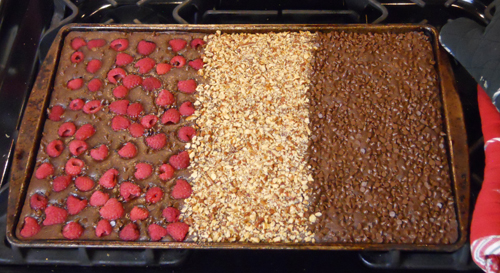
Brownies 3 ways at once

I took brownies to my dentist appointment last week. Before I handed them to the receptionist I asked, “Is it in poor taste to bring brownies to the staff in a dental office?” Before I could finish my question, she answered with a stone-faced, “No, it’s not.”

I like taking brownies places. People get really excited at the mention of the word. I think it’s a great way to make friends.

This is a triple recipe — standard fare in my kitchen. I make it in an 11 x 17 pan.

  • 3 sticks butter
  • 3 cups sugar
  • 6 eggs
  • 1-1/2 cups flour
  • 1-1/2 cups cocoa
  • 1 Tbs. vanilla

Mix, pour into greased pan, top with chips or nuts or berries (if using berries make sure they are at room temperature, and dry). Bake at 350 degrees for 25 minutes. Cut when cool, if you can wait that long. If you cut them small you can get 88 brownies.


Here’s the math for a single recipe. Bake in an 8″ x 8″ pan:

  • 1 sticks butter
  • 1 cups sugar
  • 2 eggs
  • 1/2 cups flour
  • 1/2 cups cocoa
  • 1 tsp. vanilla

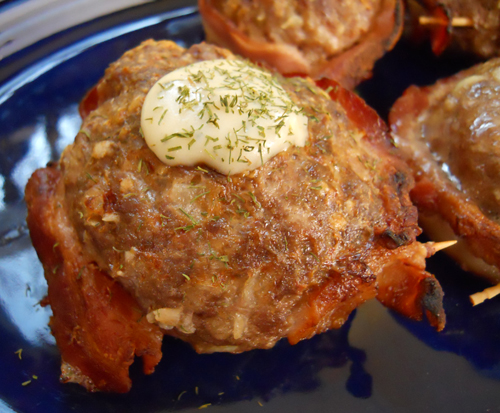
Lamb Patties in Bacon with Dill Sauce

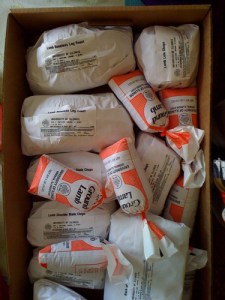
My mother-in-law and I recently bought half of a lamb from the University of Illinois meat science lab. The lab opens a meat counter three days a week, selling fresh cuts of the livestock they “harvest.” This is what a half lamb looks like:

Dorothy loves lamb the way some people love good chocolate, and she swears she would enjoy it three times a day.  She called me last night, excited to share a recipe she found in her old edition of the Better Homes and Garden cook book. I could hear her mouth watering over the phone, as she told me about the lamb patties wrapped in bacon. I made it tonight, and much to my surprise even my kids enjoyed it.

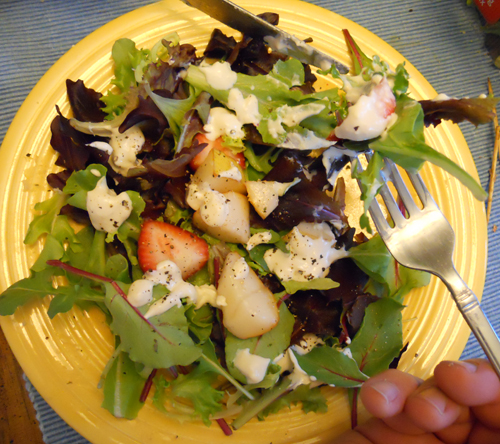
I served it with mashed potatoes, fruit salad, and a mixed green salad with home-made Caesar dressing.

Easy Japanese Dinner — Gyoza (potstickers)


Mr. Sugiyama, the former Miss Gordon, Mr. Walker, Mrs. Sugiyama, Sept. 2, 1990, Glencoe, Illinois.


Mrs. Sugiyama, my karate teacher’s wife, taught me  Japanese cooking in 1989. I went to their house every Friday morning to help Mr. Sugiyama paste up his new karate book, 25 Shotokan Kata. This was in the dark ages when we used a waxer to coat the backs of the pages and an x-acto knife to trim the edges. After I arrived at 10:00, we would have some tea, and then Sensei and I would get to work on the pages, while gossiping about the people in the dojo. “Gordon-san,” he would ask me, “How do you think of Miss Fallon? Who would be a good match for her?” And so we would talk about good match-ups for all of his students. At around 11:00 it was time for a break, and my cooking lesson with Mrs. Sugiyama began. I would go into the kitchen where she taught me the art of stuffing and hand crimping the little dumplings, and frying-then-steaming the little pot-stickers or gyoza. She used fresh pork and cabbage, seasoned with green onions. They were lovely. I remember how to make them, and every couple of years I will go to the small effort, but the easiest way to capture that crunchy, chewy dumpling experience is to head to your nearest Asian grocery store, and buy a bag of the frozen. That’s what I’m doing tomorrow. I’ll post a picture after I fry them up. Go out tomorrow and buy a bag — you can get vegetarian ones as well — and we can enjoy them together (virtually). Also, pick up some soy sauce, rice vinegar and some chili oil so we can make the dipping sauce.

My most memorable gossip session with  Sensei Sugiyama was when I asked him what he thought about Mr. Walker. “As a boyfriend, Gordon-san?”

“Yes, Sensei.”

“I can not recommend him. There is a certain sharpness in his eyes.”

While I respected Mr. Sugiyama, thankfully I did not follow his advice, and 20 years later Mr. Walker and I are still enjoying gyoza together. And, I should add, that when Mr. Walker announced our engagement right in the middle of a karate class, Sensei ran over to him and gave him a big bear hug.


Prepared, frozen gyoza. For the sauce mix 1 part soy sauce with 1/2 part rice vinegar and just a few drops of chili oil. Adjust to taste.


Very-Veggie Pasta with Cheese

DSCN0380pretty pasta w vegies sm

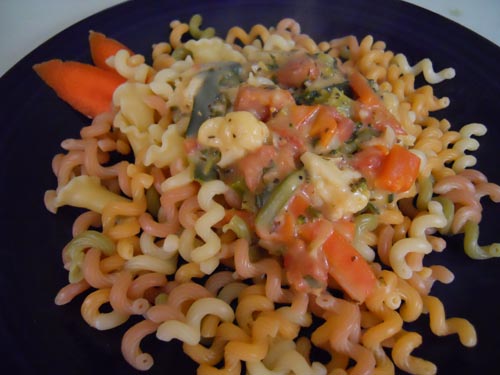
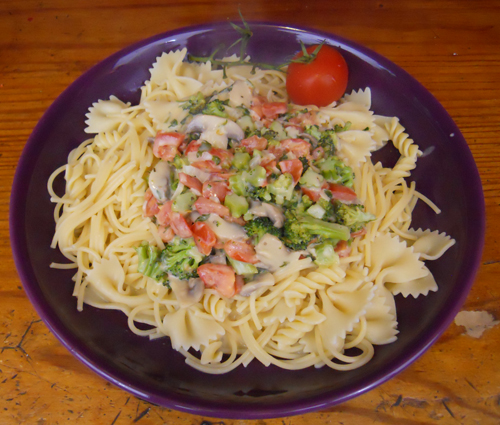
Don’t  buy boxed macaroni and cheese. Instead, make this from scratch in 30 minutes. It’s kid friendly and they get all of their vegetables right in the dish. This is one of the few dishes that all three of my children love, and even their pickiest of friends have asked for seconds.

  • 4 cups chopped vegetables
  • 1/4 onion, finely chopped
  • 4 Tbs. butter
  • 4 Tbs. flour
  • 2 cups milk (you can use soy milk)
  • 3 cups grated cheese (Use what you works for your crowd: – Kids like cheddar or cheddar-jack blend.  – Mix in some Swiss or goat cheese to suit your taste. – Tonight I used Havarti and cheedar.)
  • 1 large, fresh tomato, chopped.
  • about 1 pound of mixed pasta
  • 1 tsp. basil
  • salt and pepper

1. Get your water boiling.

2. Start the sauce:

  • Cut up the vegetables into little pieces. I like to use broccoli and/or zucchini, and mushrooms. I’ve also used thinly sliced kohlrabi, very thinly sliced carrots, cauliflower or chopped spinach. Use your favorites.
  • Saute the vegetables along with the onion in the butter until the vegetable are slightly soft. They’ll cook a bit more after you add in the milk and cheese.
  • Sprinkle the flour over the vegetables and stir it around. It will be a little pasty.
  • Slowly add the milk, a little at a time.
  • Mix in the cheese and let it melt, and add the tomatoes.
  • Season with salt, pepper and basil.

Keep this over the lowest possible heat while you boil the pasta.

  • Pick 2 or 3 different kinds of pasta shapes (bow ties, rotini, etc.). One of them should be a long shape like spaghetti or linguine, which you’re going to break into about 3″ segments before boiling. That way all of the pasta pieces will be of similar size. Boil them all in the same pot of water, taking note of cooking times and adding them one type at a time with the longest-cooking pasta going into the pot first.

Get out your biggest serving bowl, and pour the sauce over the pasta.


I’m thrilled to announce that The Plate is My Canvas is now available as a book, and includes many recipes from this blog.
The Plate is My Canvas: Recipes and Stories from My Family’s Interfaith Kitchen, 222 pages.

I’ve also published two books that are excerpts from “The Plate.”
—For just the Passover recipes, most of which are included in the “The Plate,” Essential Passover from Scratch: Recipes and Stories from My Mother’s Kitchen, 72 pages.
—For the very best of my baked goods—cookies, bread, coffee cakes, etc., You Can’t Have Dry Coffee: Papa’s Excuse to Have a Nosh And Nana’s Perfect Pastries, 86 pages.

These projects started as this food blog! From there emerged the iNosh iPad app (no longer available), and now the books. My goal in making printed copies of The Plate is My Canvas was to pass down my family’s traditions to my children, and I presented them each with the big volume in December of 2018. It’s taken a while, but now the books are available to others.

Homemade Caesar Salad Dressing

The star of tonight’s meal was the salad dressing. I remembered my mother’s Caesar recipe and threw this together in just a couple of minutes. Yes, the salmon was lovely, broiled with just a splash of soy sauce and a squeeze of a lemon; I love the brown basmati rice which is full of flavor and a little gritty; and sweet potato is a treat now that they tell us it’s healthy; but the Caesar dressing was the most exciting flavor on tonight’s plate:

  • 1 cup mayonnaise
  • 1/2 cup Parmesan cheese
  • 1/2 teaspoon Worcestershire sauce
  • 1/2 clove fresh garlic, crushed
  • 1-2″ anchovy paste

Mix it all together, adjust any of the ingredients to taste, and stir in a little milk if you like it thinner.

Gefilte Fish

For favorite Passover recipes from my kitchen, please see Essential Passover from Scratch: Recipes and Stories from My Mother’s Kitchen

I couldn’t end Passover without posting about our gefilte fish and horseradish. I’ve never eaten jarred gefilte fish. My mother and grandmother always made it fresh, so now my sister and I try and duplicate their efforts. This is the batch of 46 pieces that we made this year.

Gefilte fish are fish patties, served cold and topped with prepared horseradish. It’s made from a combination of white fish and pike. We modern women will sometimes include some salmon. The proportions are variable, but 2/3 white fish to 1/3 pike would be a good place to start. If you have a good fish counter at your grocery store, ask if they can take the fish off the bones, grind it, and then give all of it back to you — fish bones, head, tail and all.

Step 1: Make the yuch. Yiddish for broth, the “u” is pronounced with the sound of the “ou” in the word “would.” Make the yuch by boiling up all of the fish bits — skin, bones, head, tail — with an onion, some celery and carrots. The end result is a fish stock. After draining out the yucky stuff, you’re left with the yuch.

Step 2: Mix up the fish. Take the ground fish and mix in egg,  matzo meal, white pepper,  salt and  grated carrot. Mix this up in your mixer. Add just enough water to the mix for it to be a consistency that is slightly wetter than hamburger meat.

Step 3: Shape the patties. With a bowl of water near your pot of simmering stock, wet your hands, form the patties and then gently place them in the stock. Cover and let cook for 45 minutes to 1 hour. Transfer to a container to let cool. You can freeze the stock and use it later for bouillabaisse or other fish-based soups.
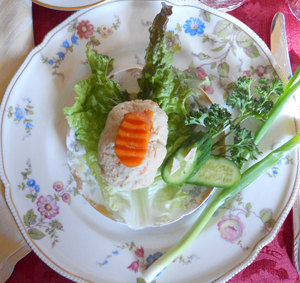
The finished product on our Seder table.

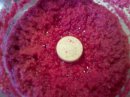
Making the horseradish was quite an experience! We started with a fresh horseradish root, peeled it, chunked it and put it in the food processor with some apple cider vinegar, some sugar, a little salt and a can of beets. Add and taste, add and taste. It did, as they say, clear our sinuses.

Here’s the recipe for gefilte fish:

Ingredients

For the fish

Order 5 pounds whole fish*, to include whitefish, trout, and northern pike, filleted and ground, with approximately the following breakdown:

  • 2½ pounds whitefish
  • ½ pound trout
  • 2 pounds northern pike (carp or salmon may also be used)
  • 1 carrot, grated
  • 2 eggs
  • 2 Tbs. matzo meal
  • ¼ tsp. white pepper
  • 1 tsp. salt
  • 1/3 c. water
  • For the broth
  • fish trimmings
  • 2 onions
  • 2 stalks celery
  • 2 carrots

*When you order the fish, ask to have it ground. Also ask that they reserve the tails, fins, heads, bones and skin—you will need all to make the fish broth.

Directions

1. Prepare the fish: If the fish store is not able to grind the fish, remove it from the bones and grind it in a food processor or meat grinder. Even after it’s filleted (by either you or the fish store) there will be fish left on the bones, so scrape off as much as you can, and combine with the rest of the ground fish.

2. Make the fish broth: Peel the onions and cut in half, peel the carrots and celery and cut them in half. Place the vegetables along with all of the fish trimmings into a large pot, and cover with about 4 quarts of water. Add 2 Tbs. of salt. Cover, bring to a boil, then reduce heat and let simmer for 2–3 hours.

3. When the broth is nearly ready, prepare the ground fish: In a large bowl, or mixer, combine all of the ground fish, the grated carrot, the eggs, matzo meal, pepper, salt, and water. Mix well.

4. Strain the broth: Set a strainer inside a large pot. Pour the fish broth through the colander to strain out the solids. Set aside the carrots; toss the rest of the solids. Bring the broth back to a simmer.

5. Prepare the fish patties: Fill a small bowl with water—you will use this to wet your hands as you work. Take about ½ cup of fish mixture into the palm of your hand, and form into a smooth, oval patty. Place gently into the simmering broth. After all patties are made, cover the pot and cook gently for 45 minutes. Remove from broth into airtight container, cool and serve with slice of cooked carrot and a dollop of ground horseradish.