
For favorite Passover recipes from my kitchen, please see Essential Passover from Scratch: Recipes and Stories from My Mother’s Kitchen

When I look at this fragile recipe card I can practically smell my grandmother Mollye’s home: honey and Fannie May chocolates, mixed with the subtle aroma of her mahogany furniture. This recipe, like most in her card box, is short on directions. Only because I was her helper during her later years, do I have any sense of what to do. What is omitted here is that she used to go to my grandfather’s bar and take out his bottle of whiskey. Using her hands, she’d pat down the wooden board with some of the alcohol, and would do the same to the top of the burning hot mixture. Nana claimed that the alcohol would act as a coolant. So now when I make the Passover ingberlach I open up that same bar, which I have inherited, and am met with the aroma of mahogany while I look for some of my husband’s whiskey.
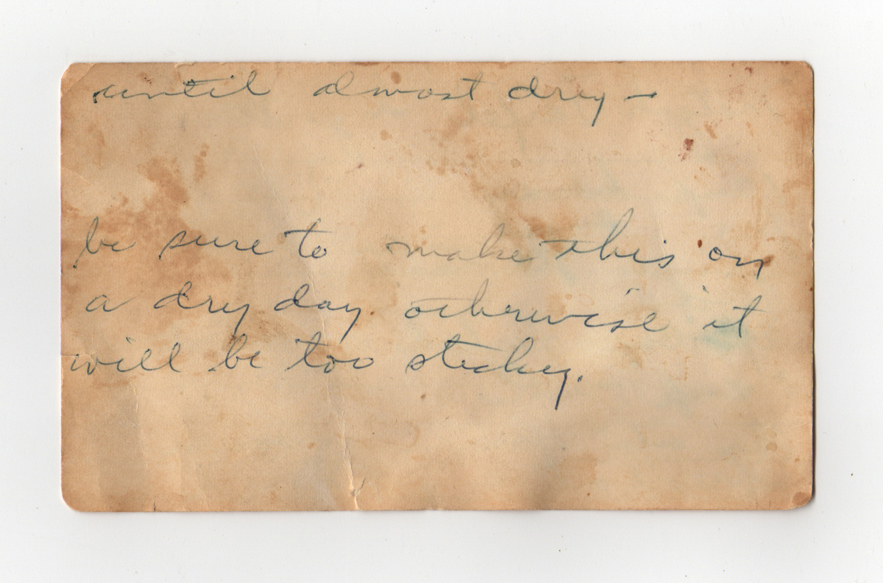
I waited for a dry day, just like Nana noted on the back side of the recipe card:

This is the finished product. You need strong teeth to bite into this candy. After it cools, tear off little pieces and coat them with a mixture of sugar and ginger.
Ingredients
- 1 c. honey
- ½ c. sugar
- 1 tsp. ginger
- 2 c. matzo farfel
- 1 c. chopped pecans
- brandy, 1/8–¼ c.
- Ginger-sugar
- 1/3 c. sugar
- 1½ tsp. ginger (or to taste)
Directions
1. Have ready a large wooden board and the brandy.
2. In a sturdy pot, stir together the honey, sugar and ginger. Bring to a boil, then add the matzo farfel and pecans. Stir constantly, for about 5 minutes, until golden brown.
3. Pour a little brandy into your hand and pat down the board. Then quickly pour out the hot farfel mixture. Spread it evenly to a thickness of about ½”. Pat it down with a little more brandy. (Be careful, as the candy will be extremely hot.) Let cool.
To finish
1. In a small bowl, mix together the ginger and sugar.
2. Tear off little pieces of the candy and coat both sides with ginger-sugar mixture.
3. Store in an airtight container.

 The Plate is My Canvas