Updating Mom’s spinach dip

The tiny sweet bell peppers are a perfect edible garnish for the standard vegies.

My mother made an extraordinary spinach dip. For the most part, Ruth was a “scratch” cook and baker, steering clear of prepackaged products: there was no Hamburger Helper for us, no cake mixes, and no t.v. dinners sitting forlornly on plastic t.v. trays. There were, however, those occasionally recipes, which I can only imagine were torn out of a Life magazine, or peeled from a product’s can, which used some questionable ingredients. The sauce for her famous stuffed cabbage rolls, for example, uses a jar of sweet pickle juice and a handful of ginger snaps, and the spinach dip uses a package of Knorr’s Leek Soup Mix, and a shake of McCormick Salad Supreme. For years when I made the spinach dip I stayed true to the recipe, but these days I try to use whole ingredients when I can, so when I made this for a New Year’s party I did a bit of updating, with no apologies to Mr. McCormick or Mr. Knorr.

Spinach Dip

  • 1 c. sour cream
  • 1 c. mayonnaise
  • 1 package frozen, shopped spinach, thawed, well drained, and squeezed as dry as possible
  • 1/2 c. fresh chopped parsley
  • 1/4 c. finely chopped onion
  • 1/2 tsp. dill weed
  • 1/4 tsp. sesame seed
  • 1/4 tsp. paprika
  • 1 small garlic clove, pressed
  • a pinch of cayenne pepper (optional)

Mix all together at least one hour before serving. Serve with fresh vegetables.

A fish chowder made from sashimi and gefilte fish stock

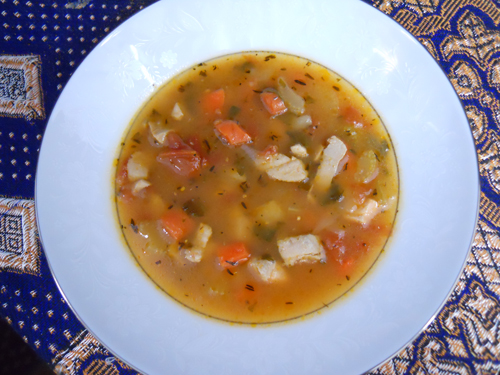
We had this fabulous chowder on New Year’s day, making use of two different kinds of leftover seafood.

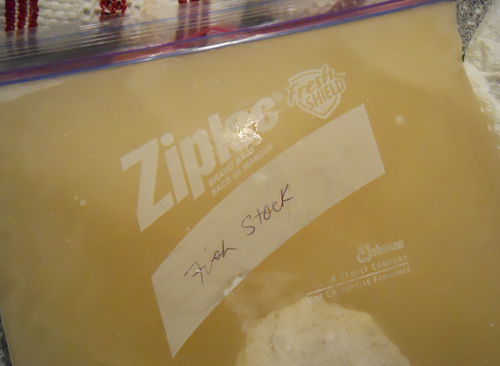
Every spring, after lovingly making the fish stock (we call it “yuch”) in which we cook the Pesach gefilte fish, I strain it and freeze it, hoping to find a use for it. Typically, the following year, I throw it away. And so, last spring’s fish stock was still sitting in my freezer this New Year’s, when we happened to have a quantity of left-over sashimi-grade fish. We had sushi for New Year’s eve. (Which, by the way, was delicious, if not visually perfect.)

Unfortunately, this chowder was fabulous—because I’m not sure if I’ll ever again have these key ingredients.

Fish Chowder (all measurements are approximate—just taste as you go)

  • 3-4 quarts fish stock (click to see our recipe for gefilte fish and the yuch, or broth)
  • 2 Tbs. olive oil
  • 1 large onion
  • 3 stalks celery, diced
  • 3 carrots, diced
  • 1 potato, diced
  • 2 large bay leaves
  • 1 c. fresh spinach, chopped
  • 1/2 c. packed chopped fresh parsley
  • 1 28 oz can tomatoes, chopped
  • thyme, salt and pepper to taste
  • 3-4 c. fresh tuna and/or salmon, cut into small chunks

Saute the onion in the olive oil. Add the celery, carrots, potato and bay leaves. Stir for about a minute, then add the fish stock, spinach, parsley, tomatoes and seasonings. Simmer until the vegetables are soft, about an hour. Right before serving add the fish. Don’t let it cook for more than 4-5 minutes so that the fish will be nice and flaky.

Two large bags of gefilte fish stock had been waiting patiently in my freezer.

A family tradition: Hand-dipped Spritz Cookies

For more tasty bakes, see my collection of family specialties:

You Can’t Have Dry Coffee: Papa’s Excuse to Have a Nosh And Nana’s Perfect Pastries

https://www.amazon.com/gp/product/B084WLZ1R7/ref=dbs_a_def_rwt_bibl_vppi_i0

It was hard to count these but we guess that we made around 300 cookies this year.

We get into a cookie-decorating frenzy each December, with the kids asking for more and more batches every year. They love to decorate these, love to eat them, and love to give them away as gifts, so this year we made around 300. The great thing about this recipe is that the cookies really do taste as good as they look. Who knows how many we’ll turn out next year?

You’ll need a cookie press to make these, and be sure to plan a little ahead so that the butter will be at room temperature.

White Spritz Cookies (makes approx. 8 dozen)

  • 1-1/2 c. butter, at room temperature
  • 1 c. sugar
  • 1 tsp. baking powder
  • 1 egg
  • 1 tsp. almond extract
  • 3-1/2 c. flour

Cream butter, then cream in sugar and baking powder. Beat in egg and almond extract, then add the flour. Do not refrigerate this dough—it must remain at room temperature to work properly in the cookie press.

Press the dough through the cookie press onto an ungreased cookie sheet. Bake at 375 degrees for 8-10 mins. Cool completely. Dip a portion of each cookie in melted chocolate then sprinkle on a topping. Lay cookie on parchment paper to dry. The cookies will keep well for a couple of weeks, sealed in an airtight container.

Chocolate Spritz Cookies (makes approx. 8 dozen)

  • 1-1/2 c. butter, at room temperature
  • 1 c. sugar
  • 1 tsp. baking powder
  • 1/4 c. unsweetened cocoa
  • 1 egg
  • 1 tsp. almond extract
  • 3-1/4 c. flour

Cream butter, then cream in sugar, baking powder and cocoa. Beat in egg and almond extract, then add the flour. Continue as with White Spritz.

Swirled Spritz Cookies

Fill the cookie press with half white and half chocolate dough.

Dark chocolate for dipping (for 1-2 batches of cookies)

  • 1 lb. dark chocolate chips (use 60% dark if possible)
  • 2 Tbs. Crisco

Melt chocolate and Crisco in a double boiler until smooth.

White chocolate for dipping (for 1-2 batches of cookies)

  • 1 lb. white chocolate chips

Melt chocolate in a double boiler, stirring occasionally until smooth.

Topping ideas

  • Ground pecans or almonds
  • Extremely finely ground coffee
  • Sprinkles
  • Toasted coconut
  • Grated chocolate

So everyone can help, we put a tray of baked cookies in the middle of the table, with multiple bowls filled with all of the chocolate and toppings. Parchment paper is placed at both ends of the table where the finished cookies are placed to dry.
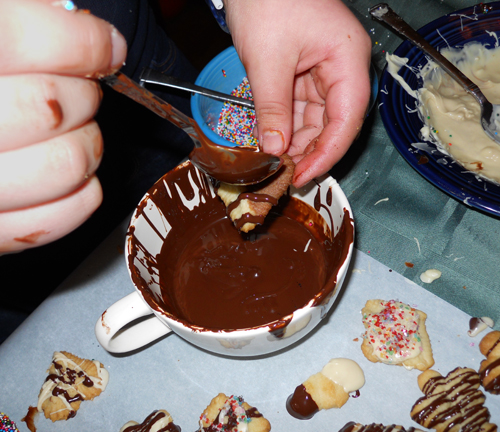
 

Either dip the cookie or use a spoon to drizzle on the chocolate.


We have a strict “may not lick your fingers” policy, but every so often a boy can’t help himself—and then he’s sent to wash up before the next cookie gets decorated!

These honestly taste as good as they look.


2010 in review

The stats helper monkeys at WordPress.com mulled over how this blog did in 2010, and here’s a high level summary of its overall blog health:

Healthy blog!

The Blog-Health-o-Meter™ reads Wow.

Crunchy numbers

Featured image

A Boeing 747-400 passenger jet can hold 416 passengers. This blog was viewed about 6,800 times in 2010. That’s about 16 full 747s.


In 2010, there were 158 new posts, not bad for the first year! There were 318 pictures uploaded, taking up a total of 50mb. That’s about 6 pictures per week.

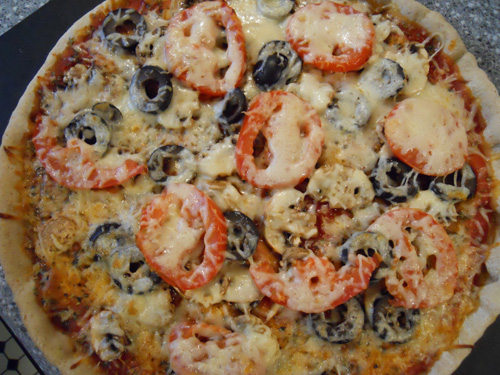
The busiest day of the year was June 18th with 121 views. The most popular post that day was Homemade thin crust pizza.

Where did they come from?

The top referring sites in 2010 were facebook.com, touch.facebook.com, google.com, alphainventions.com, and xanalytica.com.

Some visitors came searching, mostly for the plate is my canvas, yeast cookies, rugalah, rugala recipe, and my plate is my canvas.

Attractions in 2010

These are the posts and pages that got the most views in 2010.

1

Homemade thin crust pizza June 2010
2 comments

2

Walker Cafe – Always Open March 2010
10 comments

3

Gert’s Yeast Cookies (Rugalah) October 2010

4

Witches Brew Soup October 2010
8 comments

5

The circle of life: Round Challahs September 2010
7 comments

Nana’s Bread Pancakes

My grandmother taught me how to make these. It’s a good way to use up leftover bread, and a perfect breakfast for when you can’t decide whether to fix french toast or pancakes.

Bread Pancakes (serves 4)

  • 6 slices bread, broken up into little pieces
  • 2 eggs
  • 1/2 c. milk (or more)
  • 1/2 tsp. cinnamon
  • 1/4 c. raisins (optional)
  • 1 grated apple (recommended)
  • butter for frying

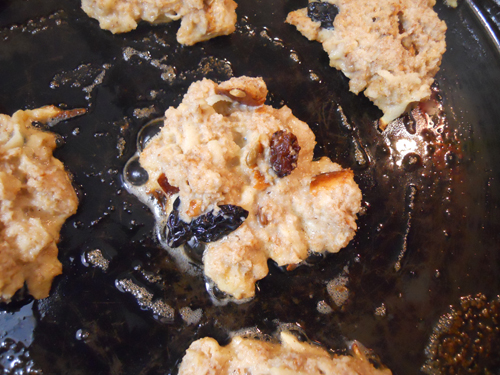
Break the bread up into a medium-sized bowl, add the eggs, cinnamon and fruit. Pour in the milk and mix it all up. Depending on how dry your bread is, you’ll probably need to add more milk, a little at a time until the bread has absorbed all that it can, becoming very mushy. You don’t want extra milk sitting in the bottom of the bowl. Drop by spoonfuls, and fry in a hot, well-buttered frying pan. When they’re brown on the bottom, turn them over and lightly flatten with a spatula, and continue cooking until the second side is nicely browned and crisp.

Mix everything together in one bowl.

Fry these in butter until they are nicely browned.

Two-step Fudge

This is as easy as it gets, making a smooth and creamy fudge in just a few minutes—no kidding.

Two-step Fudge

  • 2 c. semi-sweet or dark chocolate chips (or a mixture)
  • 1 14-oz can sweetened condensed milk
  • 1/2 c. chopped nuts, if you like

1. Put it all in a saucepan, stirring until just melted.

2. Pour into a greased pan and chill for 15 minutes.

Molasses Cornmeal Loaves

This is a full-flavored, winter bread, which goes well with your favorite soup. Often called Anadama bread (do a Google search for that story, if you wish), I chose a more descriptive name. The day I made these loaves I had no interest in following a recipe so I just started putting the ingredients that I thought made sense into the Kitchenaid mixer and the result was lovely, one that I’m happy to share. I love the flavor of molasses and the chewiness of cornmeal. Try this when you have a taste for something different.

Molasses Cornmeal Loaves (makes 2 round loaves)

  • 2-1/2 tsp. yeast
  • 2 c. warm water
  • 2/3 c. molasses plus about 1 Tbs. to proof the yeast
  • 1 c. whole wheat flour
  • 1 c. cornmeal
  • 1 Tbs. salt
  • 1/2 c. dry milk
  • 2 Tbs. olive oil
  • 4 c. white flour (approx.)

Proof the yeast in the warm water with the tablespoon of molasses. After it gets foamy stir in the whole wheat flour, cornmeal, salt, dry milk and olive oil. Stir in the white flour, a bit at a time until you are able to knead the dough. Knead for about 10 minutes. Let the dough rise for 1-2 hours, until doubled. Grease a cookie sheet, then sprinkle with a little corn meal. Form the dough into two round loaves, place onto the prepared cookie sheet, cover with a towel and let rise for 1 more hour. Then bake at 350 degrees for 35-40 minutes.

Chanukah Cookies (poppyseed sugar cookies)

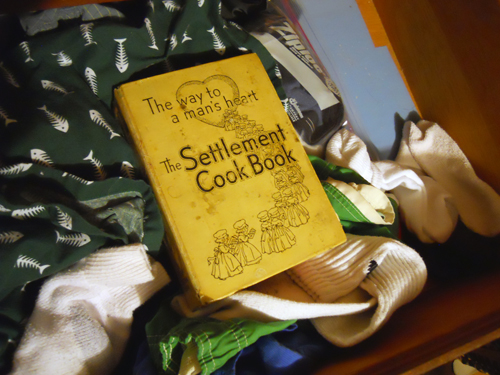
Every family has their go-to cookbook. I know friends who head right for Joy of Cooking and others who have a well-worn copy of Better Homes and Garden. In our family it is the 1946 edition of Mrs. Simon Kander’s Settlement Cookbook. This classic volume is the source of many of my family’s Jewish staples. As well as its collection of recipes it can also tell you about invalid cooking, how to make soap, and how to set a proper table; all the while adhering to its cover aphorism: “The way to a man’s heart.”

This cookie recipe is adapted from the sugar cookie recipe in The Settlement Cookbook. My mother added a good measure of poppy seeds and rolled them just as thin as possible, making a cookie so crispy and delicate that it’s easy to munch them by the handful. The poppy seeds give them a subtle flavor, very rich and not too sweet. Mom made these every year for Chanukah, although the only thing that says “Chanukah” about them is that she used Chanukah cookie cutters.

This week I made a double batch of the dough and used a variety of shapes so that I could take some to a holiday lunch party, others to a piano recital, and the rest to a Shabbat Oneg at temple. None of these events fell during Chanukah this year, but I did take my mother some of the Jewish stars, since they were once her favorite.

My copy of the Settlement cookbook was beginning to loose it’s cover so Doug got me a “new” copy of it on eBay. I gave the old copy to Joe (Joe, who is 12, wants to be a chef when he grows up), and in that copy are a lot of hand-written notes. I couldn’t remember how much poppy seed to add to the recipe so I called Joe on his cell phone and asked him where I could find his cookbook. “It’s in my underwear drawer, Mom, to keep it pristine.”

Cookies for Joe's piano recital.

Poppy Seed Cookies (adapted from The Settlement Cookbook)

  • 1/2 c. butter
  • 1 c. sugar
  • 1 egg
  • 1/4 c. milk
  • 2 tsp. baking powder
  • 1/4 tsp. vanilla
  • 2 c. flour
  • 1/4 c. poppy seeds

Cream the butter and sugar, then add the egg. Mix the baking powder with the flour. Add half of the milk to the creamed butter mixture, then half of the flour. Add the rest of the milk and vanilla, then the rest of the flour and the poppy seeds. Mix just until blended. Do not over mix or the dough will not be as flakey. Chill the dough for at least an hour in the refrigerator. Roll out very thin on a floured board. Bake on a greased cookie sheet, 375 degrees for 6-8 minutes. Keep a careful eye on the cookies while they are baking, remove them promptly when they begin to brown.

Turkey Pot Pie

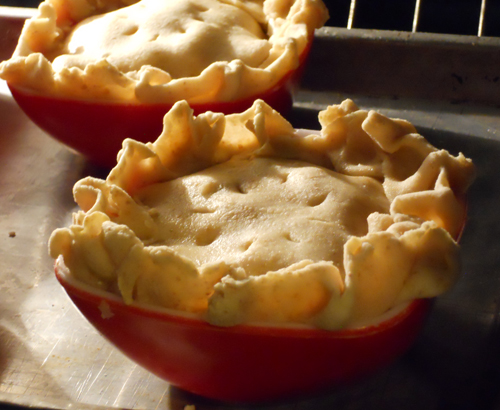
Bake the pies in some interesting oven-proof dishes and they become edible works of art.

Don’t panic—this is actually an easy dish to make! And what an elegant use for leftover turkey, chicken or beef. Not to mention that this tastes infinitely better than frozen, prepared pot pies. These can be very free-form in their assembly. Look around your kitchen for small oven-safe dishes in which to bake these. I used 4-1/2″ square Pyrex oven-proof dishes. All the kids happily dug into their dinner tonight!

Turkey Pot Pie (makes 4-5 small pies)

Pie crust for double crust pie (click here for a link to a recipe)

For the filling:

  • 1-1/2 c. cooked, chopped turkey (or other meat)
  • 1 medium onion, chopped
  • 2 medium potatoes, chopped
  • 1 large carrot, chopped
  • 3 stalks celery, chopped
  • 3/4 c. frozen peas
  • salt and pepper
  • 2 Tbs. olive oil

For the cream sauce:

  • 3 Tbs. butter
  • 4 Tbs. flour
  • 1 to 2 c. milk
  • salt
  • 1 tsp. thyme
  • 1 large bay leaf

1. Saute all of the vegetables in the olive oil until the potatoes and carrots just begin to get tender. Stir in the turkey and set aside.

2. While the vegetables are cooking, make the pie crust and set aside in the refrigerator.

3. Make the white sauce: Melt the butter in a sauce pan, whisk in the flour. Turn the heat to very low, and very slowly, while continuing to whisk, pour in the milk just a little at a time. Put in the bay leaf and thyme, and continue to stir while the sauce thickens. When it’s as thick or thin as you like, take it off the heat and set aside, season to taste with salt and pepper.

4. Assemble the pies (the fun part): Roll out the dough very thin, cut into pieces a bit larger than your baking dishes, and line the bottom of the dish, overlapping about 1/2″. Repeat for each of your dishes. Fill each dish with about 1/4 of the meat-vegie filling. Remove and discard the bay leaf from the cream sauce, and top the filling with 1/4 of sauce, then use a spoon to gently mix it down into the filling. Roll out remaining dough and cut pieces to top each pie. Fold the extra 1/2″ of bottom crust up over the top crust and roughly crimp.

5. Bake at 400 degrees for 30-40 minutes or until the crust in nicely browned. Serve piping hot.

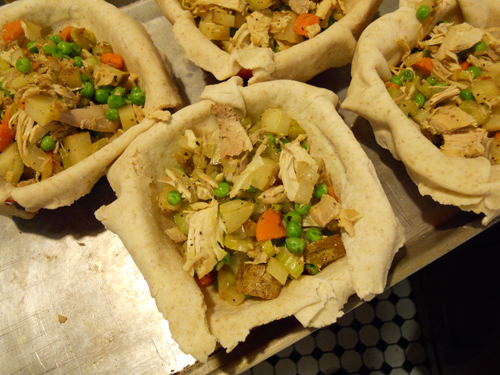
Fill each pie with 1/4 of the meat-vegie filling.

Pour over 1/4 of the cream sauce.

Just latkes

Every Jewish cook has their own favorite way to make these. My mother always peeled the potatoes and never used flour, just a handful of matzo meal. Over the years I’ve come to love them prepared by keeping the peel on the potatoes, and using the grater attachment on my food process which gives some really long, skinny bits of potato which fry up extra crunchy.

Potato Latkes (makes 14 pancakes)

  • 3 large russet potatoes
  • 2 medium onions
  • a few green onions (optional)
  • 2 eggs
  • 1/4 c. flour
  • 1 tsp. salt
  • oil for frying

Grate the potatoes and onions in a food processor. Transfer to a large bowl, squeeze out and discard liquid from the potatoes, then stir in the eggs, flour and salt. Add enough oil to cover the bottom of a pan, somewhere between 1/16″-1/8″ deep. When very hot, use a serving spoon to spoon in the batter. If possible use more than one frying pan since these are best served hot from the stove. To keep batches warm, arrange them in a single layer on a cookie sheet lined with paper towels in a warm oven.

Options:

  • substitute 1 sweet potato for one of the russet potatoes
  • add 1/2 cup chopped Swiss chard or kale
  • substitute 1 cup packed grated zucchini for one of the potatoes