What to do with the leftovers: Brisket Soup

A meal in a bowl.

Jewish meat staple or not, moist and flavorful or not—my kids don’t like brisket. This is a small problem after I have just roasted six pounds of meat. Necessity being this mother’s nudge to invent, I developed Brisket Soup. It might look like vegetable beef soup to the kids, but I know better. Yesterday’s dinner: “I don’t care for brisket;” tonight’s soup, “thumbs up.”

Brisket Soup (Vegetable-Beef Soup)

  • 1 small onion, chopped
  • 2 Tbs. olive oil
  • 6 c. roasted, chopped brisket
  • 2 c. chopped cabbage (optional)
  • 3 carrots, sliced
  • 1 large sweet potato, chopped
  • 1 c. green beans, cut
  • 1/4 c. parsley, chopped
  • 1 Tbs. salt
  • pepper
  • 2/3 c. macaroni
  • 2/3-1 c. meat gravy
  • small can of chopped tomatoes (optional, if you want a tomato base)

Saute the onion in olive oil, add all ingredients except for the macaroni, Cover with 3-4″ of water. Bring to a boil, then simmer for 1-2 hours. Fifteen minutes before serving add the macaroni.

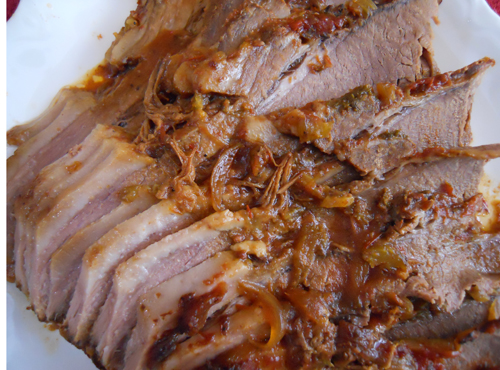
    Beer-roasted Brisket—sublime?

    An electric knife is ideal for cutting this into the thinnest possible slices.

    Brisket is the easy-to-prepare, default, Jewish meat course, served at holiday meals, not uncommonly with the obligatory kugel side dish. We eat it because it’s tradition. Honestly, it’s usually neither here-nor-there, only made palatable by eating it with a generous dollop of apple sauce. This recipe, however, from my mom, results in a juicy and flavorful piece of meat.

    Doug and I were part of an interfaith group in Albuquerque, with whom we shared holiday meals. It was there that a writer friend labeled this brisket “sublime.” We’ve never quite figured out how a piece of beef could merit praise like “sublime,” but our friend clearly loved this recipe. Unlike other favorite recipes which can be made at the last minute, this is best cooked the day before. After the meat cools, it is easy to lift the cooled fat off from the meat juices; also the chilled meat slices beautifully into lovely, thin strips.

    Ruth’s Beer-roasted Brisket (best if prepared one day in advance)

    • 5 lb. brisket
    • 2 tsp. salt
    • 1/2 tsp. pepper
    • 2 onions, sliced
    • 4 stalks celery, sliced
    • 1 bottle chili sauce (look for Heinz or Del Monte brands, near the ketchup)
    • 1 beer

    Season beef with salt and pepper and put in a large roasting pan. Place onion, celery, and chili sauce on the meat, and add 1/4 c. water to bottom of pan. Roast uncovered at 325 degrees, basting often for 2-1/2 hours. Pour on the beer, cover and roast for an additional 1-1/2 hours.

    (If desired, at this point you may eat the meat. It will not slice very well, however it will be moist and tender like a delicious roast.)

    Let meat come to room temperature and refrigerate overnight. Lift off fat and slice meat as thinly as possible. Place the meat back into the juices and reheat either on the stove top, or in the microwave.

    Gert’s Yeast Cookies (Rugelach)

    These are my mother’s favorite cookie.

    This is, by far, the finest pastry in my mother’s recipe book—my Great Aunt Gert’s yeast cookie, which is a traditional rugelach. Some rugelach recipes use cream cheese while others use sour cream and yeast; this one uses them all. They are exquisitely delicate with a meringue filling that melts in your mouth.


    Ingredients

    For the dough

    • ½ lb. butter (2 sticks)
    • 2/3 of an 8 oz package
      of cream cheese
    • 3 packages of yeast (6¾ tsp.)
    • 3 egg yolks, beaten
    • ½ c. sour cream
    • 4 c. of flour (or a bit less)
    • confectioners sugar

    For the meringue filling

    • 3 egg whites
    • 1 c. sugar
    • ½ tsp. cinnamon
    • for the filling topping
    • chopped walnuts (or pecans), about 1 c.
    • raisins, about 1 c.

    Directions

    1. Blend together butter, cream cheese and yeast.
    2. Mix in egg yolks and sour cream, then flour, a little at a time, until the dough is quite stiff and not too sticky. Shape into a ball and set aside.
    3. To make the filling: beat the egg whites until stiff, then slowly mix in the sugar and cinnamon.
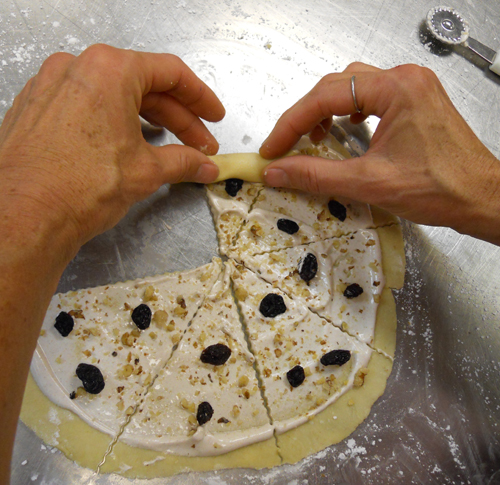
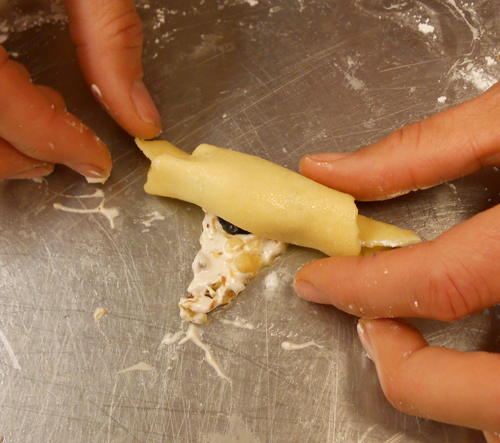
    4. To assemble (see photos): cut the dough into 10 equal portions. Make a ball out of each and, on a board dusted with confectioners sugar, roll out into a 9˝ circle. Spread a portion (one-tenth) of the filling over the circle of dough. Sprinkle with nuts. Using a pizza slicer, or a sharp knife, cut the dough into 8–10 wedges. Place 3 or 4 raisins on each wedge. Roll up, starting from the outside of the circle. Cover and let rise for 30 mins.
    5. Place on ungreased cookie sheet and bake at 375° until golden brown (about 20–25 mins).

    The temple bakers stocking the freezer with rugalah for upcoming onegs. (Kirsten, Jennie, Rae and Vicki)

    Roll them from the outside of the circle into the center.

    Waiting all year for Ruth’s Plum Cake

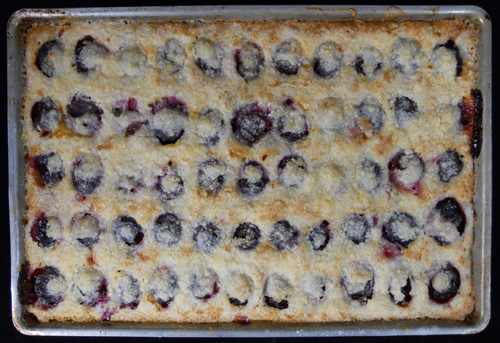
    Mom knew she needed 27-1/2 plums for this cake.

    Navigating my mother’s recipe book is tricky—to make her famous plum cake you must look for the Cherry Cake recipe card. I don’t think I ever tasted the cherry cake, only plum and occasionally peach.  Italian plums, or prune plums, are only available for a few weeks every autumn, which in our home meant that we traditionally ate this around the High Holidays. In the off season, Mom sometimes substituted canned peaches, which is also delicious.


    Ingredients

    • 28 Italian plums (prune plums), halved and pitted
    • 2 c. flour
    • 2 sticks butter
    • 1 c. sugar
    • 4 eggs
    • ²/₃ c. sugar
    • 1 Tbs. milk


    Directions

    1. In a large bowl, mix together the flour and sugar, then cut in the butter. Take off one cup and set aside for topping.

    2. Mix in 2 eggs.

    3. Spread the very thick batter over the bottom of a
    10″ x 15″ pan.

    4. Place the plum halves, cut side down, in even rows and columns over the batter.

    5. Beat together remaining 2 eggs, the ²/₃ c. sugar and milk, and spread over the plums. Sprinkle with reserved crumbs.

    6. Bake at 350° for 45–55 minutes, until golden brown.

    The circle of life: Round Challahs

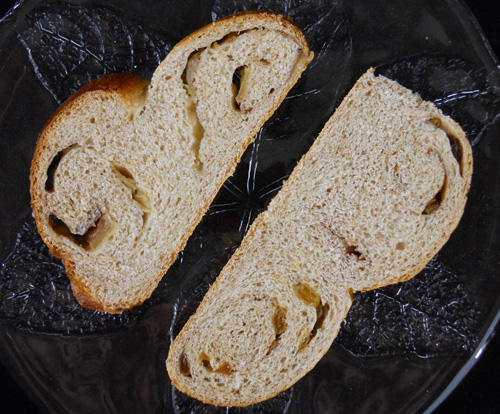
    Slices of the round challahs. Apple on the left; raisin on the right.

    Last night as I said kaddish for my dad during the Kol Nidre service, I remembered all of the times I sat next to him and my grandfather as they stood in temple to say kaddish for their parents. The melodic cadence of the prayer was effortlessly recited by them both. But in that Reform temple of my childhood only the men said kaddish—a throw-back to more traditional practices. In my current, more traditional yet also more modern congregation, everyone recites the prayer, and I’ve been practicing for the past few years knowing that at any time it might be my turn, and I did not want to disappoint. There was no way to anticipate how emotional that moment would be for me.

    My father died three weeks ago. Yesterday, before going to temple, I felt like baking again. And how fitting that the first thing I baked since his death were the holiday challahs, round to symbolize the circle of life and the cycle of the seasons; extra sweet so that we’ll all have a sweet year.

    The round challahs are unique to both of the high holidays: Rosh Hashana and Yom Kippur. Our local Jewish Federation has a group that does outreach programs for the seniors in our community. Over the years I’ve been asked to bake dozens of very small, individual, round challahs to contribute to one of their outreach programs. For Chanukah, Purim and the High Holidays they distribute little gift bags to Jewish elderly shut-ins around town, and when my father first moved in with us two years ago, he began receiving these bags. At first I thought it was a silly gesture, after all, my dad had the real thing, right here in our home! He didn’t need the little hamentaschen, or the tiny challahs—mine were baked for him fresh! But to my surprise he loved the bags. He happily showed the contents to me when I got home from work, and he took great pleasure in having little candies of his own that he could share with my children. For Rosh Hashana he would receive a small bottle of grape juice, applesauce, honey, a small round challah, some chocolates, some raisins and a one-page summary of the holiday which he would read carefully with his magnifying glass. What a lovely mitzvah (good deed) this is!

    Ten days ago, right before Rosh Hashana I was surprised by a gift bag which was brought to me by Lee, the former director of our local Jewish federation. She brought me a giant version of the bag that they make for the seniors, with enough of everything to feed all five of us, including a full-sized challah, made fresh that morning by Lee herself. She said that she felt funny bringing a challah to the challah baker, but my heart was not in baking that week, and her gift couldn’t have been more appropriate. I was so moved by that gift.

    For the raisin bread, drizzle on some honey, sprinkle on raisins and cinammon.

    Arrange a thin layer of apples for the apple bread. Or grate an apple and wring out the juice before spreading over the dough.
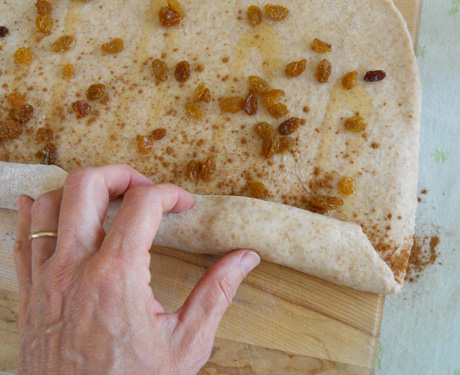
    Roll it up. Use both hands and work evenly across the length.
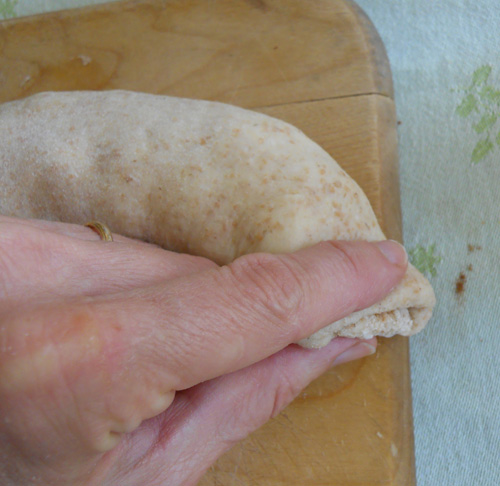
    Pinch the ends.

    Make the coil. Place it seam side down, and tuck under the end.

    Here the coils are ready to rise. They can sit together like this on the same baking sheet. It’s okay if they kiss a little when they bake!

    Here are the just-baked breads. It’s okay if they come together while baking. Just gently pull them apart.

    Here’s Macey in his favorite chair, hoping for a hot plate on the dinner table and a taste of some hot, fresh challah.


    Ingredients

    For the dough:

    • 1 package yeast (2¼ tsp.)
    • 2/3 c. sugar
    • 2 c. warm water
    • 1 egg
    • 3 Tbs. oil
    • 1 Tbs. salt
    • 2 c. whole wheat flour
    • 4 c. (about) white flour

    Mix together and brush on before baking:

    • 1 egg
    • 1 Tbs. honey

    Sprinkle with:

    • sunflower, poppy and/or sesame seeds, about ¼  cup total


    Directions

    1. Proof the yeast: Mix together the yeast and sugar, add the warm water, stir, and let it sit for 20 minutes. It should get foamy.
    2. Add the rest of the dough ingredients, putting in just enough white flour to make a smooth, not sticky dough.
      Knead for about 10 minutes.
    3. Cover and let rise for about 3 hours, or until doubled in size. Shape into two small loaves or one large loaf. Place loaves on a greased cookie sheet or into greased loaf pans if you want sandwich-shaped loaves. Cover and let rise for one more hour.
    4. Brush with the egg/honey mixture and sprinkle with some seeds. Bake at 350˚ for 35–40 minutes. (Add 5–10 more minutes for a challah that’s stuffed and rolled, covering with foil for the last 15 minutes to prevent the top from burning.)


    You can find more tasty bakes in my newly released cookbooks:

    You Can’t Have Dry Coffee: Papa’s Excuse to Have a Nosh And Nana’s Perfect Pastries
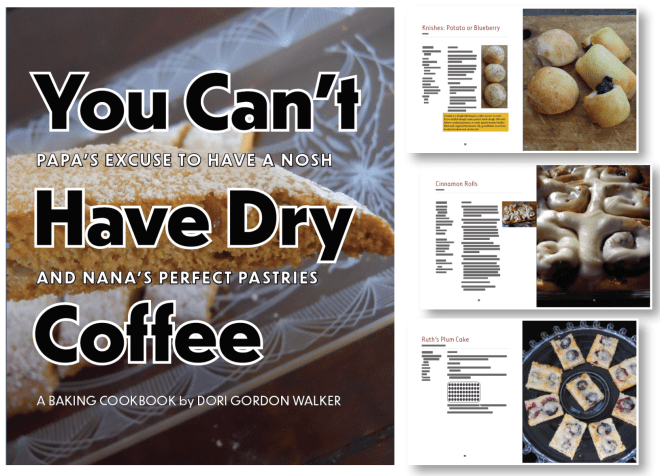
    Dry Coffee promo

    “You can’t have dry coffee,” was what my grandfather would say when reaching for one of my grandmother’s delicious cookies or pastries. Elegant rugelach and mandel bread, tart plum cake, delicate cream cheese cookies, and sweet babka—these fancy treats started me on my life-long love of baking. Along with those classics, this collection has challahs, bagels, bialys, plus modern-day luscious treats like chocolate cream cheese brownies, and the best chewy, peanut butter chocolate cookies I’ve ever had.Whether my grandfather was being ironic, or if something was lost in translation from Yiddish, I’ll never know. But ironic or not, a cup of coffee needs a good nosh, and this book is a compilation of our family’s best.

    The Plate is My Canvas: Recipes and Stories from My Family’s Interfaith Kitchen

    Plate promo shot

    Written in the style of a family memoir, with stories from my family, this book includes all of the Jewish classics, from rugelach to latkes. Married to a Lutheran man, I learned to cook my husband’s family’s classics as well—with help from my mother-in-law’s handwritten recipes. Stunning photographs accompany each recipe. A perfect gift for an interfaith family.

    image

    Another idea for the big harvest: Zucchini Pancakes (off-season latkes)

    This batter is so colorful with zucchini, carrots and a small purple potato.

    These pancakes are very versatile: zucchini, carrots, potatoes, kale, chard and green onions are just some of the possible list of ingredients. If you have a bountiful harvest of zucchini then you can use 100% zucchini and they will be delicious. The recipe uses 6 cups of vegetables and you can mix and match as you please. Our dinner pancakes were made with 1 onion, 1 carrot, 1 small purple potato and the rest zucchini.

    Zucchini-vegetable pancakes (makes about 16 pancakes)

    • 6 c. shredded vegetables (of the six cups, it is best to have about 1 cup of onion)
    • 2 eggs
    • 2/3 c. flour
    • 1/2 tsp. pepper
    • 1 tsp. salt
    • oil for frying

    Lightly beat the eggs, mix in the vegetables, and then the flour, salt and pepper. Cover the bottom of a large skillet with a small amount of oil, no more than 1/8″ deep. Heat until very hot, then drop batter by large spoonful. Brown well before turning over. Remove from pan and place on a cookie sheet that is lined with paper towels. Set in warm oven while frying subsequent batches.

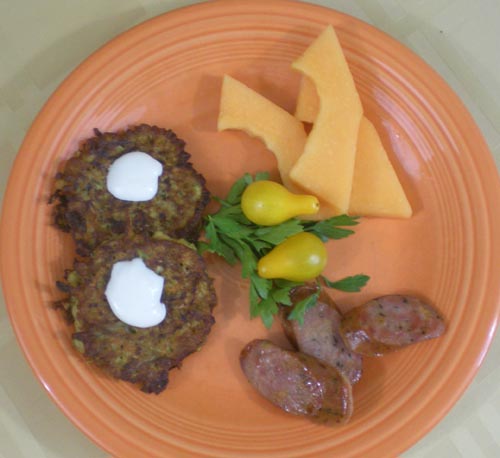
    Zucchini pancakes, melon, fresh yellow tomatoes and grilled sausage.

    Having fun with challah dough: Knishes and Blueberry Buns

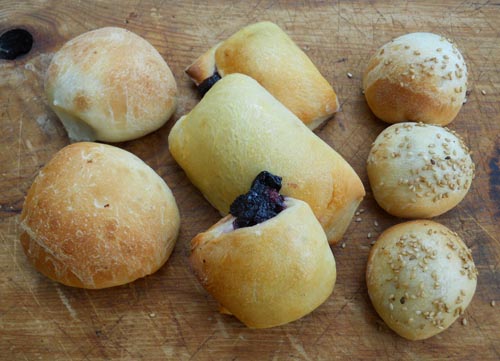
    Potato knishes, blueberry buns and knishes with sesame seeds.

    It takes a village to make knishes and buns.

    The thing that I possibly love best about being Jewish is the food—the passing down of recipes, the sharing within our community, and the beauty of the culinary traditions. Some of them are so odd and involve an acquired taste: my grandmother slapping the board with whiskey to make her Passover candy, the cleaning of the fish bones to make gefilte fish and boiling up the broth we call yuch, and the tradition of cooking with chicken fat or schmaltz.

    Blogging, apparently has broadened my community. I had never heard of blueberry buns until I received a comment last week from a woman named Irene Saiger, telling me of her family’s tradition of taking challah dough and filling it with sugared fresh blueberries. She invited me to try her recipe: click here for a link to that.

    I couldn’t imagine why our family had never tried this, so I made them today. And since I was going to the effort of filling circles of rolled out challah I decided to make some potato knishes as well. A potato knish is another kind of challah bun, this one savory, stuffed with mashed potatoes. At their best they are made with chicken fat—schmaltz—both as part of the mashed potatoes as well as brushed onto the dough before baking. My mother always had chicken fat on hand. She would tear it off of the chicken every week and keep a bag full in the freezer, along with chicken livers, saving both until she had enough of each to make chopped liver. Years ago I started saving up chicken fat in the freezer. But I never used it for anything. Today I found the bag but it was, well, rancid. My kind neighbor, Bev, volunteered to stop by the store and pick up a fat chicken for me. And then I thought of Ben, five houses down, who loves to make his own chicken stock and matzo balls with schmaltz. “Ben,” I asked, “Do you, by any chance, have any chicken fat in your freezer?” “I have a jar in the refrigerator, still fresh. I’ll bring it right over,” he said.

    What are the odds of finding a neighbor in the middle of east central Illinois with a jar of schmaltz in their fridge?


    Ida’s Yeast Cake

    Ida’s yeast cake is rising on my attic floor. While the a.c. is running downstairs, the attic is hot and steamy and a terrific place to leave a yeast cake to rise. This is the dough our family uses to make hamentashen for Purim, and it also makes wonderful babkas and coffee cakes. Today I’m making two coffee cakes, filled with almonds, golden raisins, chocolate chips, cinnamon and honey.

    The following is all I have for the recipe:

    This is the recipe—just a list.

    I’m really never sure in what order to mix them, but it always turns out just fine. Mix together the ingredients, then refrigerate for about an hour. This recipe will make enough dough for two good sized coffee cakes, or for one babka, which would be baked in a bundt pan. For the coffee cake, divide the dough into two, roll out very thin and fill with whatever sounds good. Then roll it up, coil it into a circle and tuck the end under. Let rise, covered, for 1 hour. Then bake at 325 degrees for 35-45 minutes or until nicely browned. If you want the coffee cake to be covered with chocolate, then remove it from the oven and sprinkle on some chocolate chips. Put it back in the oven for 1 minute, then take it out and use a metal knife to spread the chocolate around. Sprinkle on some nuts or more chips if you like.

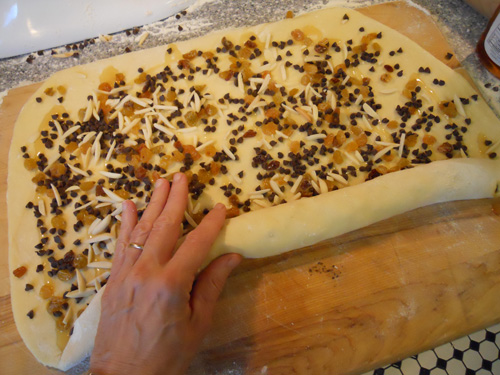
    This coffee cake is filled with honey, cinnamon, golden raisins, chocolate chips and slivered almonds.

    All coiled up and rising in the hot, steamy attic.

    Ingredients

    • 1 c. milk, warmed
    • 1 Tbs. yeast
    • pinch of sugar
    • 2 sticks butter, softened
    • ½ c. sugar
    • 3 eggs
    • 4 c. flour
    • ½ tsp. salt
    • 1 tsp. grated lemon rind

    For the filling—use any/all/other:

    • chocolate chips
    • golden raisins
    • a drizzle of honey
    • a sprinkle of cinnamon
    • slivered almonds

    Directions

    • In a small bowl, stir together the warm milk, the yeast and the pinch of sugar. Set aside to proof.
    • Cream together the butter and sugar.
    • Add the eggs, one at a time, mix together (it will be lumpy), then add the salt and lemon rind.
    • Stir in half the flour, then the milk/yeast mixture, then the rest of the flour. Mix well.
    • Refrigerate the dough for one hour or overnight.
    • On a liberally floured board, roll out dough to about 1/8˝ thickness.

      Cover dough with desired filling. From the long edge, roll up the dough into a tight coil.

    • Form the coffee cakes, each one on its own greased baking sheet.
      For a thicker coffee cake: form a simple spiral, tucking the end under.
      For a fluted-edge, fancy coffee cake (at right): form coil into a C-shape. Make slits in the dough, at about 2″ intervals, cutting about halfway through the coil. Lift each of the 2″ segments and turn 90°.

    • Cover the cakes with a towel. Preheat the oven to 350˚. Let cakes rise for 30 minutes. Bake for about 35 minutes or until lightly browned. Loosen the cakes and when slightly cooled, transfer to a cooling rack.

    Playing with my food.

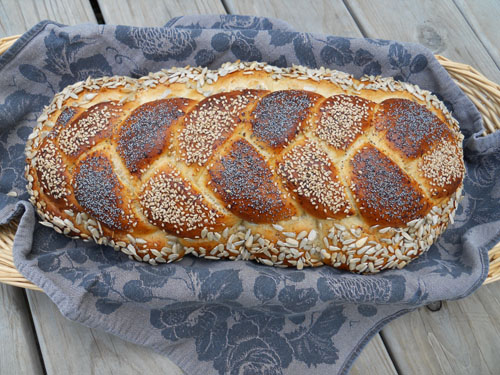
    Careful placement of the seeds really brings out the braid on this loaf.

    I went to Mary Pat and Dave’s going away party last night. Our beloved, former neighbors, who are now friends for life, are moving to New Zealand. The party invitation said that, if we liked, we could bring bread or a dessert. Bread. I can do that.

    I did something new with this challah, taking extra time to carefully place the seeds. I poured the seeds into a small, thin-edged metal measuring cup, and very carefully shook them into place on the glazed bread before baking, creating a lovingly prepared piece of edible art.