
I’ve been tempted for years, and today I decided to try something new and try my hand at a 6-strand braid. I looked on the internet for guidance and found multiple sites with step-by-step instructions. It wasn’t hard, and how pretty it is.

I’ve been tempted for years, and today I decided to try something new and try my hand at a 6-strand braid. I looked on the internet for guidance and found multiple sites with step-by-step instructions. It wasn’t hard, and how pretty it is.
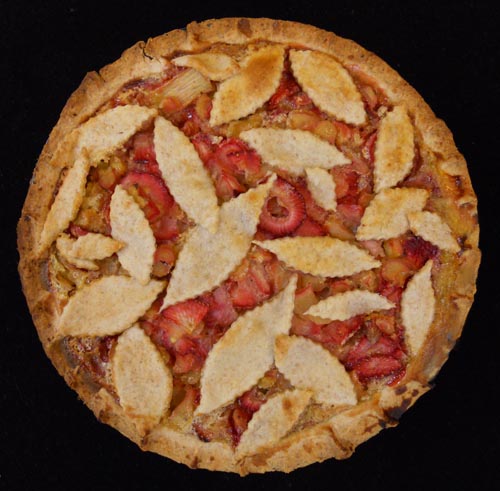
This free-form leaf motif top crust is my antidote to a lattice top. Shown here on a rhubarb-custard pie. Custard pies don't freeze well, so we ate this one while still warm.
There aren’t many things that get me as excited as when someone brings me a bag of fresh seasonal fruit. Just consider the possibilities! Jam, conserve, chutney, crisp, crumble, marmalade, muffins, pie? So when 26 cups of rhubarb found its way into my kitchen this morning (thank you, Lori Day), I eliminated the other options, and all I could think about was pies.

This traditional strawberry rhubarb pie is headed to the freezer.

Try different shapes to decorate the top of the pie. Just lay them over the filling before placing the pie in the oven.

A fluted wheel cutter easily creates leaf shapes.

Why stick with round? This double-recipe pie was made in a 13" x 9" pan, and is for an event at the Shavuot Confirmation service at Temple. The ten commandments is the theme for the confirmation class's speeches.
Strawberry-Rhubarb Custard Pie
Mix together egg and milk, stir in dry ingredients, and then stir in strawberries and rhubarb. Pour into pie crust, top with second crust in either a lattice-style or a covered top crust with vent holes. Bake at 400 degrees for 50-60 minutes, until crust is browned and the filling is set.
Liz’s Lemony Strawberry-Rhubarb Pie
Mix together flour and sugar, then toss with lemon zest and fruit. Pour into pie crust, top with second crust in either a lattice-style or a covered top crust with vent holes. Bake at 400 degrees for about 40-50 minutes, or until crust is brown and the pie is bubbly.
Pastry for a 2-crust pie

By the way, in case you’ve been keeping track, pie #6 wasn’t very photogenic. We’ll eat that one tomorrow.

Suzie’s chocolate bars are in the oven. For hamentashen or babka there’s nothing finer than Ida’s yeast dough, and for an elegant, flaky, bakery-class cookie I go for Gert’s. They are the baker matriarchs whose names head up the treasured recipes in my mother’s card box, and looking through the recipes is like following the jagged lines of a family tree. Recipes with names in the title are like found treasures, taking you back to a loved-one’s kitchen—that is if you know who the person is. I’m a little hazy on which Suzie made the bars that are in my oven, and I’m pretty sure Ida Cash, an old friend of my grandmother’s, is responsible for the yeast dough, but I do remember my great aunt Gert, and think about her when I make her cookies.
What names are on your recipe cards?
Suzie’s Chocolate Bars
For the crust, mix together, and press into a 13 x 9 pan:
Bake at 350 degrees for 10 mins. Remove from oven and sprinkle with:
Put back in oven for 1 minute and then remove and spread around the chocolate.
Mix together the following:
Spread over the top of the chocolate, return to oven and bake for 30-35 mins. Cut into bars when cool.

It's not haute cuisine, but there is no finer comfort than homemade chicken soup.
While my chicken was baking tonight I made this gorgeous little pot of chicken noodle soup, with enough for every one to have a bowl full. For a quick batch of soup, put the back of the chicken into a medium-sized pot, add an onion, a chopped carrot and celery stalk, a clove of garlic, salt and pepper, cover with water and let it simmer for a couple of hours. And if you’re not sick of rosemary yet, you can add a sprig, along with a handful of chopped parsley or some frozen peas if you have them. Right before you’re ready to eat pour in some tiny egg noodles.
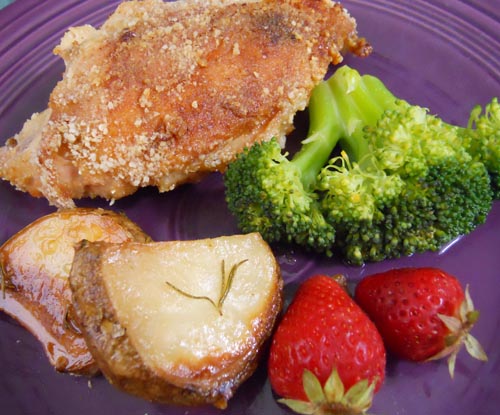
Mom’s baked chicken, served with rosemary potatoes, broccoli and strawberries.
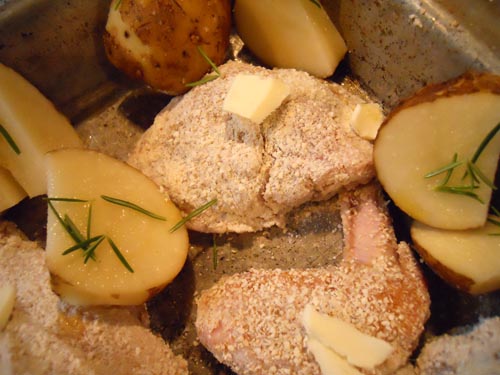
Chicken and potatoes ready for the oven. Bake them together.
I just put this chicken and potatoes in the oven. It only took 5 minutes to prepare this crisp, flavorful and succulent chicken, and now I can sit back and wait for dinner. I’ll add some fresh steamed broccoli, and will enjoy a superb meal with less than 10 minutes of total prep time—does it get any easier than this?
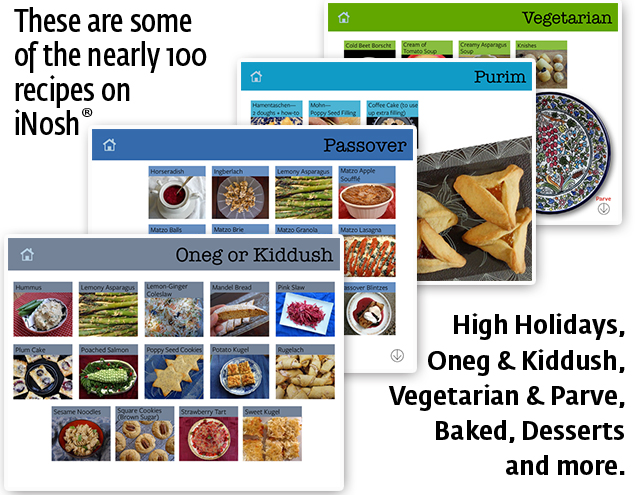
If you’d enjoy the recipe, please visit the Apple iTunes store to download my app, iNosh. Here’s the link for that:
https://itunes.apple.com/us/app/inosh/id777362589?ls=1&mt=8
I’m donating half of the proceeds to Mazon, A Jewish Response to Hunger.
And here’s a preview of some of the content on the app. For now, it’s only available for iPad users.
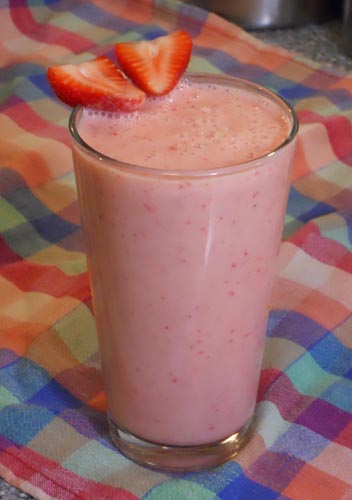
Molly, my daughter, is named after Mollye, my grandmother.
Mollye taught be everything I know about the art of food. I learned how to run the fork down the side of the cucumber before slicing it, to crinkle cut melons, to make radish florets and soak them in ice water so they expand. Mollye taught me how to curl butter into roses for fancy parties, how to slice and turn the edge of a coffee cake, how to arrange cookies, and fruit, and how to decorate a fish to look like, well, a fish.
So it was with great pleasure that, tonight, when Molly made herself a strawberry smoothie for a snack, she reached for the aesthetic of the moment. She saved out one strawberry, sliced it in half and then made careful grooves in each half so that she could carefully, and with great intention, garnish her glass. All for herself. For the sheer beauty and pleasure of the experience.
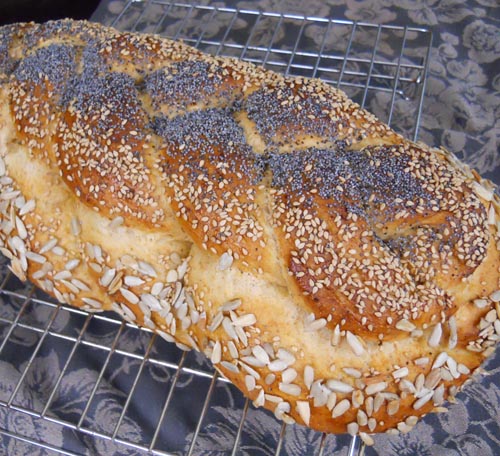
Tonight I made our challah with three kinds of seeds: sunflower, sesame and poppy. It makes a lovely bread, and while it bakes the seeds get toasted adding a flavorful crunch to the crust.
If you want to put seeds on baked goods, then do so deliberately, with focused intention. Don’t just dump them willy-nilly all over the top. Be mindful of the process. Have a plan and go about your business executing it in good taste.

Dori taking the kids out in the Swedish double-buggy.
Picture this photo with a five year-old standing on a running board between my arms, and two large, braided loaves of challah riding on the rack beneath the little kids’ bottoms. That was the image the time this city girl decided to enter her bread in the New Mexico State Fair. (And I’m pretty sure that’s the day the buggy exceeded it’s weight limit, and one of the wheels became warped.)
We were living in the mountains just outside of Albuquerque, in a somewhat isolated area, where a trip to the big grocery store meant a 20 mile car ride. With three kids at home, ages 5, 4 and 2, I was happy to putter around the house, rather than wrangle them all into the car, and so it happened that I spent a lot of time baking bread. I challenged myself to go without using store-bought bread. Through a co-op we belonged to at the time, I ordered 50 pound bags of different kinds of flour. I baked whole wheat bread, molasses bread and a beautiful two-toned swirly bread, but our favorite was the challah I learned to bake from my Cousin Betty’s recipe.
Our mountain newspaper had a notice that the New Mexico State Fair was coming to Albuquerque. Being raised in a North Shore suburb of Chicago, I’d never so much as set foot in a state fair before, but I knew that people took bread and had it judged there. Doug was out of the country for two weeks and I was looking for something interesting to do, so I decided to enter.
I entered two separate contests: The Fleischmann’s Yeast Bread contest (with a cash prize), and the New Mexico State Fair bread contest. As I filled out the paperwork the official asked me for my empty Fleischmann’s yeast packages so she could staple them to the entry form. I’m a pretty loyal Red Star yeast user, so her request made me pause. She didn’t miss a beat, thankfully, and handed me a three-pack and a pair of scissors. “There’s a trash can under the table.” I snipped off the ends, emptied that sad yeast into the trash can, and handed her the packages to staple to my Fleischmann’s entry form.
My sister-in-law, Donna, a veteran fair goer, later informed me that picking one’s category is crucial when entering a contest. But at the time I didn’t give it a lot of thought and I chose the “holiday bread” category because challah is a Jewish sabbath bread, and the sabbath is our most important holiday — right? Unfortunately, Easter sticky buns fell into the same category. In fact, there were over 30 breads in the holiday bread competition.
The judging was fascinating. A celebrity food judge from one of the local television stations was tasting the breads for the Fleischmann’s contest. I watched with my three squirmy kids, still buckled into the buggy, while the judge took a slice from the very center of each loaf, holding some up as examples of having a good “crumb” or crust.
The kids held out long enough for my bread to be held up by the judge, who said that he was from Philadelphia and he knew what challah tasted like and that this was the best challah he’d ever had. I won a big fancy third place ribbon, and $30, which almost paid for parking and four ice creams. Later, when I talked with the judge, he told me that I should have entered in the international category. Maybe next time.
I had to drive the 20 miles back up into the mountains so that I could get Max to afternoon kindergarten, and I missed the judging of my other loaf. I called later to find out the results and learned that I had won the first place ribbon in the New Mexico bread contest. They put the bread on display in the case for the 10 remaining days of the fair and asked if I wanted it back at the end. I said no. But I did go to town to fetch my ribbons, and I framed them to display in my kitchen. With thanks to Betty Jane for her fine recipe.

My framed ribbons on the right. On the left is a “Santo,” a painted image of a saint that I got in Taos, New Mexico. On the back it says: Saint Marta. Patroness of housewives, dietitians, domestic workers, waitresses and lay sisters, invoked to protect the home.
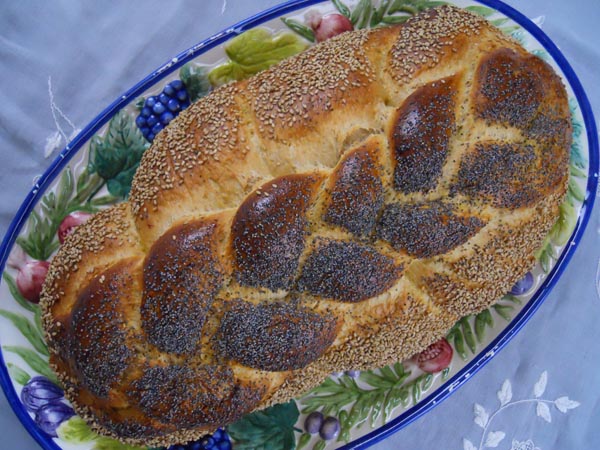
Ingredients
For the dough:
Mix together and brush on before baking:
Sprinkle with:
Directions
The Plate is My Canvas: Recipes and Stories from My Family’s Interfaith Kitchen

and
You Can’t Have Dry Coffee: Papa’s Excuse to Have a Nosh And Nana’s Perfect Pastries
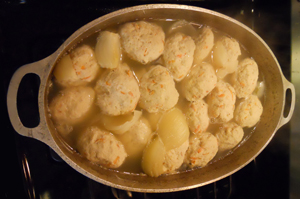
I couldn’t end Passover without posting about our gefilte fish and horseradish. I’ve never eaten jarred gefilte fish. My mother and grandmother always made it fresh, so now my sister and I try and duplicate their efforts. This is the batch of 46 pieces that we made this year.
Gefilte fish are fish patties, served cold and topped with prepared horseradish. It’s made from a combination of white fish and pike. We modern women will sometimes include some salmon. The proportions are variable, but 2/3 white fish to 1/3 pike would be a good place to start. If you have a good fish counter at your grocery store, ask if they can take the fish off the bones, grind it, and then give all of it back to you — fish bones, head, tail and all.
Step 1: Make the yuch. Yiddish for broth, the “u” is pronounced with the sound of the “ou” in the word “would.” Make the yuch by boiling up all of the fish bits — skin, bones, head, tail — with an onion, some celery and carrots. The end result is a fish stock. After draining out the yucky stuff, you’re left with the yuch.
Step 2: Mix up the fish. Take the ground fish and mix in egg, matzo meal, white pepper, salt and grated carrot. Mix this up in your mixer. Add just enough water to the mix for it to be a consistency that is slightly wetter than hamburger meat.
Step 3: Shape the patties. With a bowl of water near your pot of simmering stock, wet your hands, form the patties and then gently place them in the stock. Cover and let cook for 45 minutes to 1 hour. Transfer to a container to let cool. You can freeze the stock and use it later for bouillabaisse or other fish-based soups.
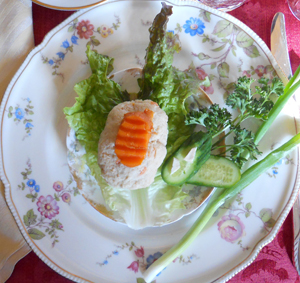
The finished product on our Seder table.
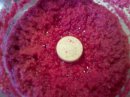
Making the horseradish was quite an experience! We started with a fresh horseradish root, peeled it, chunked it and put it in the food processor with some apple cider vinegar, some sugar, a little salt and a can of beets. Add and taste, add and taste. It did, as they say, clear our sinuses.
Here’s the recipe for gefilte fish:
Order 5 pounds whole fish*, to include whitefish, trout, and northern pike, filleted and ground, with approximately the following breakdown:
*When you order the fish, ask to have it ground. Also ask that they reserve the tails, fins, heads, bones and skin—you will need all to make the fish broth.
1. Prepare the fish: If the fish store is not able to grind the fish, remove it from the bones and grind it in a food processor or meat grinder. Even after it’s filleted (by either you or the fish store) there will be fish left on the bones, so scrape off as much as you can, and combine with the rest of the ground fish.
2. Make the fish broth: Peel the onions and cut in half, peel the carrots and celery and cut them in half. Place the vegetables along with all of the fish trimmings into a large pot, and cover with about 4 quarts of water. Add 2 Tbs. of salt. Cover, bring to a boil, then reduce heat and let simmer for 2–3 hours.
3. When the broth is nearly ready, prepare the ground fish: In a large bowl, or mixer, combine all of the ground fish, the grated carrot, the eggs, matzo meal, pepper, salt, and water. Mix well.
4. Strain the broth: Set a strainer inside a large pot. Pour the fish broth through the colander to strain out the solids. Set aside the carrots; toss the rest of the solids. Bring the broth back to a simmer.
5. Prepare the fish patties: Fill a small bowl with water—you will use this to wet your hands as you work. Take about ½ cup of fish mixture into the palm of your hand, and form into a smooth, oval patty. Place gently into the simmering broth. After all patties are made, cover the pot and cook gently for 45 minutes. Remove from broth into airtight container, cool and serve with slice of cooked carrot and a dollop of ground horseradish.
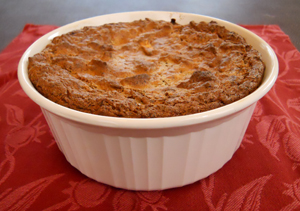
My mother baked this once a year, using the recipe as a way to use up leftover Passover charoset. If you don’t have that then use some grated apples and cinnamon. We loved it as kids, looking forward to it every year. And now my kids do too! It’s an apply souffle, but don’t be scared off by the word souffle since it’s simple to make.
or
1. Crumble up the matzo in a bowl. Run warm water over the matzo until wet, then drain.
2. Mix together all of the ingredients except the egg whites.
3. Beat the egg whites until stiff and fold into the mixture.
4. Bake in a greased, 2-quart round soufflé dish at 350° for one hour or until golden brown. Serve hot.
 The Plate is My Canvas