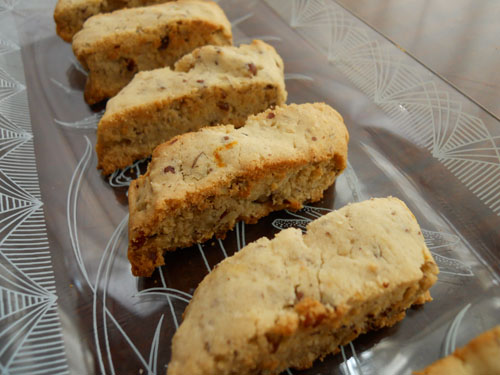
Passover Mandel Bread

My grandmother Mollye’s recipe card box is a family heirloom.

As my grandmother Mollye got older she would ask me to come over to help her bake. Her Passover favorites were mandel bread, rocks, teiglach and ingberlach. Instead of flour, the Passover mandel bread recipe calls for potato starch and matzo cake meal, which give the cookie an extremely fine texture.


Ingredients

  • ½ lb. butter
  • 1 c. sugar
  • 4 eggs
  • 1 Tbs. grated orange rind
  • 1½ c. matzo cake meal
  • ½ c. potato starch
  • 1 c. chopped pecans

Directions

  1. Cream butter and sugar.
  2. Add the eggs and orange rind.
  3. Mix together the cake meal and potato starch and add to the wet ingredients.
  4. Stir in the nuts.
  5. Refrigerate for at least an hour, or overnight.
  6. Hand roll into eight 1″ rolls, placed about 4 inches apart onto greased cookie sheets, then flatten using the palm of your hand.
  7. Bake at 350° for 20–25 mins, or until very slightly browned.
  8. Remove from oven and cut into ¾” diagonal slices; turn each cookie 90° onto a cut edge and return to oven to bake for another 8–10 mins.
  9. Remove from oven and flip each cookie over onto the other cut edge; return to oven for another 8–10 mins.
  10. If you like, sprinkle the warm cookies with a mixture of sugar and cinnamon.

For favorite Passover recipes from my kitchen, please see Essential Passover from Scratch: Recipes and Stories from My Mother’s Kitchen

passover promo shot


Counting down to Pesach: Matzo Granola and Matzo Pizza

This is an exceptionally delicious granola, and tastes great dry as a snack, or with milk as a breakfast cereal.

Ingredients

  • 4 c. matzo farfel
  • ½ c. nuts
  • ¾ c. shredded coconut
  • ½ c. honey
  • ½ c. oil
  • ½ c. raisins, dried cherries, dried cranberries, or a combination

Directions

  1. Mix together the matzo farfel, nuts and coconut.
  2. Mix together the honey and oil.
  3. Mix together the two mixtures.
  4. Spread evenly on a cookie sheet, bake at 350° for 15–20 minutes, stirring frequently.
  5. When cool add raisins or other dried fruit. Seal in airtight container.

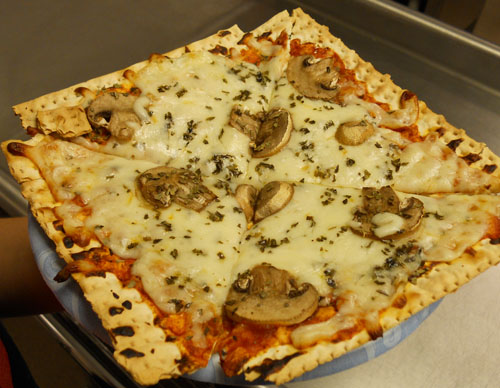
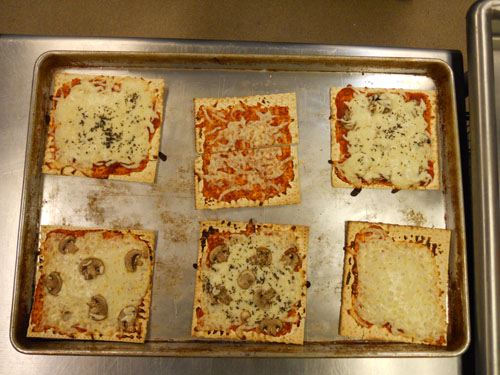
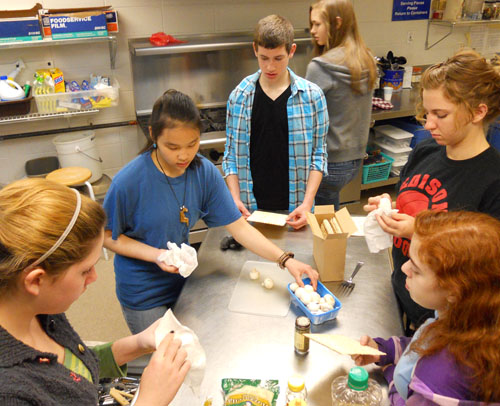
Rae and I were at it again at temple this morning, showing the high-schoolers some Passover recipes. First we stirred up a batch of granola, and then, while the granola was in the oven, we made some matzo pizzas.

Matzo makes a pretty terrific pizza crust!

Its easy to customize these single-serving pizzas.

For favorite Passover recipes from my kitchen, please see Essential Passover from Scratch: Recipes and Stories from My Mother’s Kitchen

passover promo shot

Hamantaschen Dough II — cookie dough

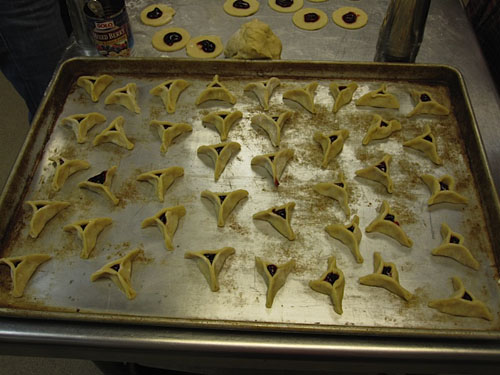
Rae Spooner and I, along with our kitchen sisters and teens, had our annual hamantaschen baking at temple this morning. We were assigned the task of making enough hamantaschen to feed the kids and parents at the Purim carnival, with no specific instructions as to the quantity needed. So Rae and I arrived at the temple kitchen with nine batches of dough pre-made and ready to do some production baking.  Lisa and Pat joined us, then Molly and little Helen, and then the teens in the baking class. We rolled, cut, filled, shaped and baked. We filled an industrial-sized tray with hamantaschen and every once in a while we’d wonder if we had enough. How many did we make? Finally I couldn’t stand it anymore. Something my mother passed down to me kicked in—my mother who would count each piece of gefilte fish as they plopped into the yuch, every matzo ball as it hit the soup, every cabbage roll… you get the idea. I had to know the numbers. So Rae and I transferred all of the hamantaschen to a new pan, taking turns counting off by tens, scribbling numbers on a pad. I even opened the oven to count how many were baking. Our grand total: 555 pieces, and a very good morning.

This dough is something like a sugar cookie, but easier to handle and not quite as sweet. These are filled with canned Solo Cake and Pastry Filling, but you can also use a thick jam dusted with a little flour.

Ingredients

  • 3 c. flour
  • 2½ tsp. baking powder
  • 1 c. butter
  • 1 c. sugar
  • 2 eggs
  • 4 Tbs. orange juice

Directions

  1. In a medium bowl, combine flour and baking powder.
  2. Cream together butter and sugar.
  3. Add eggs, one at a time.
  4. Stir in half of the orange juice, then half of the flour; remainder of orange juice and remainder of flour.
  5. Refrigerate for a few hours or overnight.
  6. On a liberally floured board, roll out dough to about 1/8˝ thickness. Cut into approx. 2½” circles. Fill with jam or pie filling, form and bake at 350° for 10–12 minutes.

We made about a dozen sheets like this.

Dry Coffee promo

For more tasty bakes, see my collection of family specialties:

You Can’t Have Dry Coffee: Papa’s Excuse to Have a Nosh And Nana’s Perfect Pastries

https://www.amazon.com/gp/product/B084WLZ1R7/ref=dbs_a_def_rwt_bibl_vppi_i0


Poppy Seed Filling for Hamantaschen (mohn)

Hamantaschen sitting on my Grandmother’s Civil War era plate.

I saw the can of poppy seed filling in the baking aisle last week, and wondered, “how horrible must that be?” Yes, I am a snob. I won’t go near a jar of gefilte fish either, for I was blessed to have a mother who made all of the Jewish delicacies from scratch. So every year she would send someone down to Devon Avenue, to the Jewish neighborhood in Chicago, to get a bag of ground poppy seeds for the Purim hamantaschen. She cooked up this magical concoction with honey, raspberry jam, ground almonds… once a year we got to taste this creation. If you enjoy cooking, then you know that the act of creating the dish is as good as enjoying the taste. What a pleasure to grate in the fresh lemon zest (I’ve been enjoying the lingering aroma on my fingers), and to stir in the dollop of jam, and watch as the pats of butter melt and the mixture thickens. Of course the best part will be rolling out the hamantaschen with the kids later today, and watching their pleasure as they taste one hot from the oven.

My mom would make about as many hamantaschen as she could stand, and then would roll out the rest of the filling into an elegant coffee cake, with tender layers of pastry and thin layers of filling, this was her little secret: the coffee cake is better than the hamantaschen.

Yeast Dough

Ingredients

  • 1 c. milk, warmed
  • 1 Tbs. yeast
  • pinch of sugar
  • 2 sticks butter, softened
  • ½ c. sugar
  • 3 eggs
  • 4 c. flour
  • ½ tsp. salt
  • 1 tsp. grated lemon rind

Directions

  1. In a small bowl, stir together the warm milk, the yeast and the pinch of sugar. Set aside to proof.
  2. Cream together the butter and sugar.
  3. Add the eggs, one at a time, mix together (it will be lumpy), then add the salt and lemon rind.
  4. Stir in half the flour, then the milk/yeast mixture, then the rest of the flour. Mix well.
  5. Refrigerate the dough for one hour or overnight.
  6. On a liberally floured board, roll out dough to about 1/8˝ thickness. Cut into approx. 2½” circles. Fill with poppy seed filling (next page) or jam, form and bake at 350° for 12–15 minutes.


Poppy Seed Filling (Mohn)

Ingredients

  • 1 c. poppy seed (plus a little extra to clean out your coffee grinder)
  • 1 c. milk
  • 2 Tbs. butter
  • 2 Tbs. honey
  • ½ c. chopped almonds
  • grated rind of 1 lemon
  • ¼ c. golden raisins
  • ¼ c. sugar
  • 1 tart apple, peeled and grated
  • ¼ c. raspberry jam

Directions

  1. Wipe out your coffee grinder, grind about a tablespoon of poppy seeds, then throw that away.
  2. Grind the cup of poppy seeds, and put them in a saucepan with all of the ingredients except for the apple and jam. Cook until thickened, stirring constantly.
  3. Let it cool, then stir in the apple and jam.

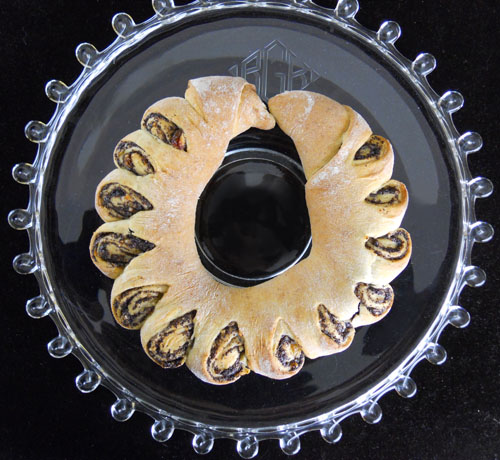
This coffee cake baked up a little flat (very sticky dough today). I made the side on the left with the swirls turned to face in to each other; the side on the right with them all turned the same direction. It is sitting on my mother’s monogrammed cake plate.

This one baked the way I like it, and held its shape beautifully. The dough had a little more flour and wasn’t so sticky to work with.

Here’s a detail showing the pretty layers.

Roll out the dough, cut into circles, put on a dollop of filling, then pinch up and around the filling to form a triangular shape.

Roll out a large rectangle of dough and spread on a thin layer of filling, being careful not to tear the dough, then roll it all up.

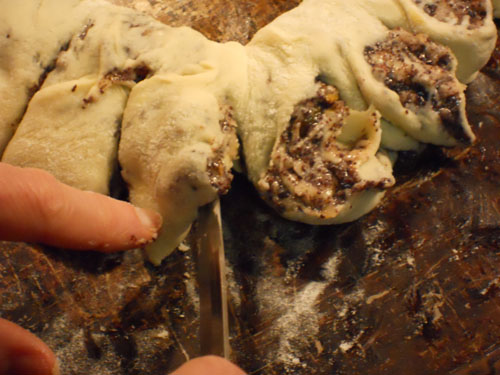
Form the roll into a U-shape and cut slices all the way through.

Slip a knife under each section, gently lift it up and twist it 90 degrees.


A family classic: Mom’s Stuffed Cabbage Rolls (sweet and sour)

Once a year, after the really big cabbages arrived in the store, Mom would make stuffed cabbage. This was a family delicacy and we four kids loved this dish. I remember taking a piece of that good white bread Mom would buy and dunking it right into the serving bowl, and then eating the soggy, sweet, orange-colored slice.

The recipe was lost, but my sister recently found it scrawled on the back of an envelope. Mom’s version called for using the juice from a jar of sweet pickles but, quite honestly, even though it was common practice when I was a kid, the thought of using that now makes me a little ill. Tonight I made it without the pickle juice, and I think it’s a perfect taste-replica of Mom’s recipe. Unfortunately, unlike me and my siblings, 2/3 of my kids won’t even taste it, and I made 15 pieces. Fortunately, it does quite well in the freezer.

makes about 15 pieces

Ingredients

  • 1 large cabbage, approx. 4 lbs.
  • 2 lbs. ground beef
  • 28 oz. can tomato puree plus ½ can of water
  • ½ c. sugar
  • ¼ c. cider vinegar
  • 12 ginger snaps
  • 1 onion, sliced
  • ½ c. raisins
  • 9 oz. prunes, pitted
  • salt
  • flat toothpicks

Directions

1. Core the cabbage and place it cut side down in a large pot filled with a few inches of salted water. Steam the cabbage for about 10–15 minutes, run it under cold water, and gently remove the outermost, steamed leaves. Return the cabbage to the pot and steam again, repeating as necessary until you can easily remove all of the biggest leaves. Chop up the center of the cabbage and set aside.

2. In a very large roasting pan or deep soup pot, add the tomato puree, water, sugar, vinegar, ginger snaps, onion, raisins, prunes, the reserved chopped cabbage and 1½ teaspoons of salt. Bring it to a boil and reduce heat to a low simmer.

3. While the gravy is heating up, prepare the cabbage rolls. Mix the ground beef with 1 teaspoon of salt.

4. Roll up a 2″ x 1″ oval portion of meat inside a cabbage leaf, and secure with a toothpick.

5.
Place each roll, toothpick side down, into the pot, on top of the gravy. Chop up any extra cabbage leaves and put them, along with reserved chopped cabbage, into the pot. Simmer, covered, for about 3 hours, basting occasionally, until the leaves are very soft and somewhat transparent, and the meat is fully cooked. Serve over egg noodles or rice.

Click here to watch a video of rolling up the cabbage.

Place the cabbage rolls on the gravy.

These are best served over rice or on top of egg noodles.


This recipe is included in my cookbook:

The Plate is My Canvas: Recipes and Stories from My Family’s Interfaith Kitchen

https://www.amazon.com/Plate-My-Canvas-Recipes-Interfaith/dp/1790773431/ref=sr_1_1?keywords=the+plate+is+my+canvas&qid=1582410159&s=books&sr=1-1

Written in the style of a family memoir, with stories from the author’s family, this book includes all of the Jewish classics, from rugelach to latkes. Married to a Lutheran man, Walker learned to cook her husband’s family’s classics as well—with help from her mother-in-law’s handwritten recipes. Stunning photographs accompany each recipe. A perfect gift for an interfaith family.

Valentine’s Day: Heart-shaped bread from challah

This is a peanut butter and apple sandwich. Also try a classic cream cheese and jelly, being sure to use a red-colored jam.

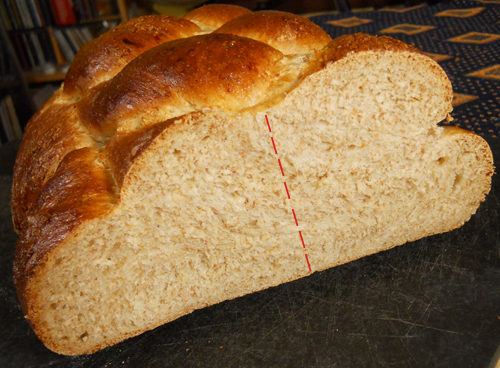
This is a terrific trick that will wow your kids. Let them watch as you cut off a slice of your challah, then cut it in half to make a heart. It’s a little bit of slicing magic that little kids love. Don’t worry if your slices don’t result in perfect cookie-cutter hearts; the kids won’t care. If you want you can do a little extra trimming to fine-tune the edges. I like that the top and side crusts are still there.

Use this bread for sandwiches or for a special French toast Valentine’s Day breakfast.

It’s very easy to make a double-braided challah:

Make up a batch of Blue Ribbon Challah.

Divide dough into 4 equal portions. Braid 3 and place on the greased cookie sheet. Divide the remaining portion into 3 equal portions, braid those and place on top of the first braid.

Here's where to slice it. You can do some additional trimming if you like.


A fish chowder made from sashimi and gefilte fish stock

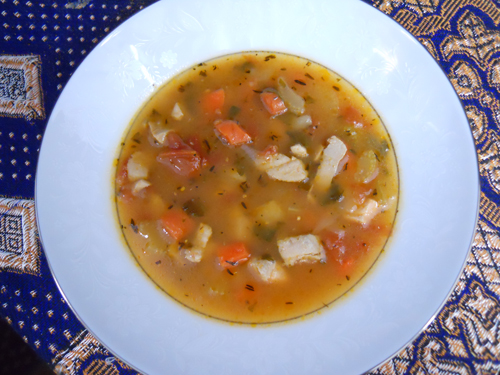
We had this fabulous chowder on New Year’s day, making use of two different kinds of leftover seafood.

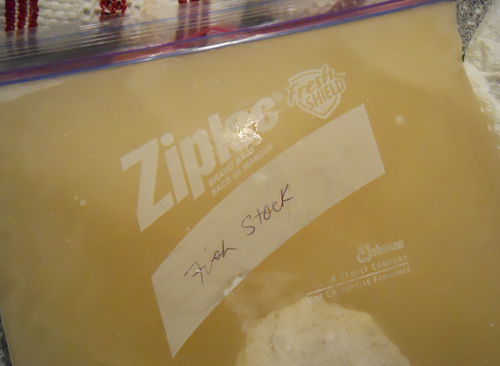
Every spring, after lovingly making the fish stock (we call it “yuch”) in which we cook the Pesach gefilte fish, I strain it and freeze it, hoping to find a use for it. Typically, the following year, I throw it away. And so, last spring’s fish stock was still sitting in my freezer this New Year’s, when we happened to have a quantity of left-over sashimi-grade fish. We had sushi for New Year’s eve. (Which, by the way, was delicious, if not visually perfect.)

Unfortunately, this chowder was fabulous—because I’m not sure if I’ll ever again have these key ingredients.

Fish Chowder (all measurements are approximate—just taste as you go)

  • 3-4 quarts fish stock (click to see our recipe for gefilte fish and the yuch, or broth)
  • 2 Tbs. olive oil
  • 1 large onion
  • 3 stalks celery, diced
  • 3 carrots, diced
  • 1 potato, diced
  • 2 large bay leaves
  • 1 c. fresh spinach, chopped
  • 1/2 c. packed chopped fresh parsley
  • 1 28 oz can tomatoes, chopped
  • thyme, salt and pepper to taste
  • 3-4 c. fresh tuna and/or salmon, cut into small chunks

Saute the onion in the olive oil. Add the celery, carrots, potato and bay leaves. Stir for about a minute, then add the fish stock, spinach, parsley, tomatoes and seasonings. Simmer until the vegetables are soft, about an hour. Right before serving add the fish. Don’t let it cook for more than 4-5 minutes so that the fish will be nice and flaky.

Two large bags of gefilte fish stock had been waiting patiently in my freezer.

Chanukah Cookies (poppyseed sugar cookies)

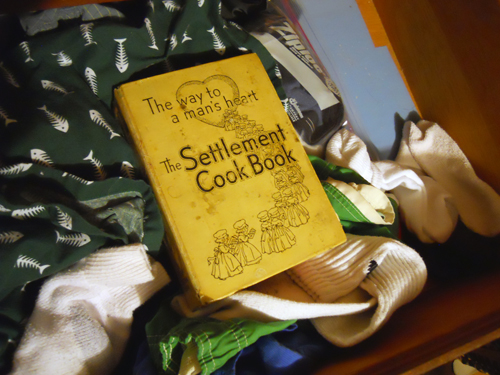
Every family has their go-to cookbook. I know friends who head right for Joy of Cooking and others who have a well-worn copy of Better Homes and Garden. In our family it is the 1946 edition of Mrs. Simon Kander’s Settlement Cookbook. This classic volume is the source of many of my family’s Jewish staples. As well as its collection of recipes it can also tell you about invalid cooking, how to make soap, and how to set a proper table; all the while adhering to its cover aphorism: “The way to a man’s heart.”

This cookie recipe is adapted from the sugar cookie recipe in The Settlement Cookbook. My mother added a good measure of poppy seeds and rolled them just as thin as possible, making a cookie so crispy and delicate that it’s easy to munch them by the handful. The poppy seeds give them a subtle flavor, very rich and not too sweet. Mom made these every year for Chanukah, although the only thing that says “Chanukah” about them is that she used Chanukah cookie cutters.

This week I made a double batch of the dough and used a variety of shapes so that I could take some to a holiday lunch party, others to a piano recital, and the rest to a Shabbat Oneg at temple. None of these events fell during Chanukah this year, but I did take my mother some of the Jewish stars, since they were once her favorite.

My copy of the Settlement cookbook was beginning to loose it’s cover so Doug got me a “new” copy of it on eBay. I gave the old copy to Joe (Joe, who is 12, wants to be a chef when he grows up), and in that copy are a lot of hand-written notes. I couldn’t remember how much poppy seed to add to the recipe so I called Joe on his cell phone and asked him where I could find his cookbook. “It’s in my underwear drawer, Mom, to keep it pristine.”

Cookies for Joe's piano recital.

Poppy Seed Cookies (adapted from The Settlement Cookbook)

  • 1/2 c. butter
  • 1 c. sugar
  • 1 egg
  • 1/4 c. milk
  • 2 tsp. baking powder
  • 1/4 tsp. vanilla
  • 2 c. flour
  • 1/4 c. poppy seeds

Cream the butter and sugar, then add the egg. Mix the baking powder with the flour. Add half of the milk to the creamed butter mixture, then half of the flour. Add the rest of the milk and vanilla, then the rest of the flour and the poppy seeds. Mix just until blended. Do not over mix or the dough will not be as flakey. Chill the dough for at least an hour in the refrigerator. Roll out very thin on a floured board. Bake on a greased cookie sheet, 375 degrees for 6-8 minutes. Keep a careful eye on the cookies while they are baking, remove them promptly when they begin to brown.

Just latkes

Every Jewish cook has their own favorite way to make these. My mother always peeled the potatoes and never used flour, just a handful of matzo meal. Over the years I’ve come to love them prepared by keeping the peel on the potatoes, and using the grater attachment on my food process which gives some really long, skinny bits of potato which fry up extra crunchy.

Potato Latkes (makes 14 pancakes)

  • 3 large russet potatoes
  • 2 medium onions
  • a few green onions (optional)
  • 2 eggs
  • 1/4 c. flour
  • 1 tsp. salt
  • oil for frying

Grate the potatoes and onions in a food processor. Transfer to a large bowl, squeeze out and discard liquid from the potatoes, then stir in the eggs, flour and salt. Add enough oil to cover the bottom of a pan, somewhere between 1/16″-1/8″ deep. When very hot, use a serving spoon to spoon in the batter. If possible use more than one frying pan since these are best served hot from the stove. To keep batches warm, arrange them in a single layer on a cookie sheet lined with paper towels in a warm oven.

Options:

  • substitute 1 sweet potato for one of the russet potatoes
  • add 1/2 cup chopped Swiss chard or kale
  • substitute 1 cup packed grated zucchini for one of the potatoes

Mandel Bread

Mandel bread is the most basic of Jewish cookies, and has always been a staple on our holiday cookie platter. They look like biscotti, but are as delicate and crumbly as a butter cookie. Crisp, browned, and crunchy, these cookies are not for soft-cookie lovers. The secret is that they are baked three times, slicing and rotating the cookies for even browning. For my husband, who happens to be a soft-cookie lover, I take out  some of the ends (which we lovingly refer to as the mandel butts) after the first bake so he can enjoy the goodness. Traditionally made with almonds (mandel=almond), feel free to substitute your favorite nut, to add mini chocolate chips or chopped, dried fruit.


Ingredients

  • ½ lb butter
  • 2 Tbs. Crisco
    (optional)*
  • 1 c. sugar
  • 3 eggs
  • 1 tsp. vanilla
  • 3 c. flour
  • 1 tsp. baking powder
  • ¼ tsp. baking soda
  • pinch salt
  • ½ c. chopped pecans
  • 1 c. mini chocolate chips
    (optional)

Directions

  1. Cream butter, Crisco and sugar.
  2. Add eggs and vanilla, and then the dry ingredients.
  3. Stir in the nuts and/or chips.
  4. Refrigerate dough for about 2 hours (or spread the dough thin along the edges of a metal bowl and freeze for 20 minutes).
  5. Hand roll into eight 1″ rolls, placed about 4 inches apart onto greased cookie sheets, then flatten using the palm of your hand.
  6. Bake at 350° for 20–25 mins, or until very slightly browned.
  7. Remove from oven and cut into ¾” diagonal slices, turn each cookie 90° onto a cut edge and return to oven to bake for another 8–10 mins.
  8. Remove from oven and flip each cookie over onto the other cut edge, return to oven for another 8–10 mins.
*makes a bit flakier cookie

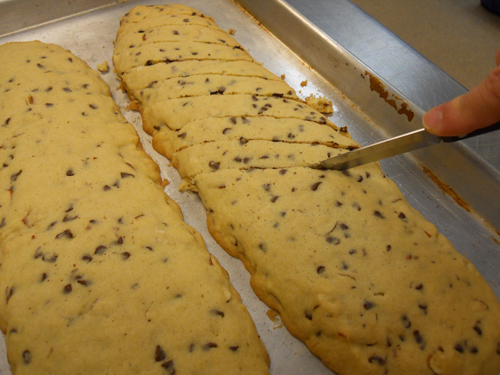
After the first baking, the mandel bread is sliced. Use a very sharp knife (or one that is serrated) so that you are slicing through the dough without pushing it down.

Turn each cookie onto a cut edge, return to oven, repeat.

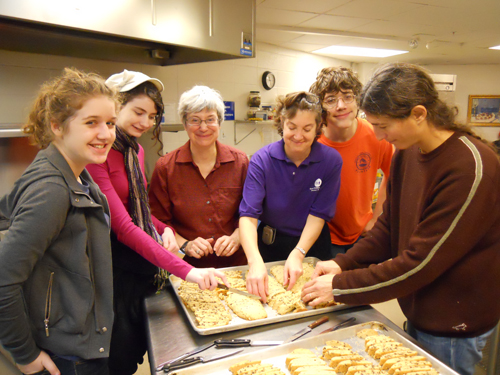
Members of our temple got together to bake on Sunday.